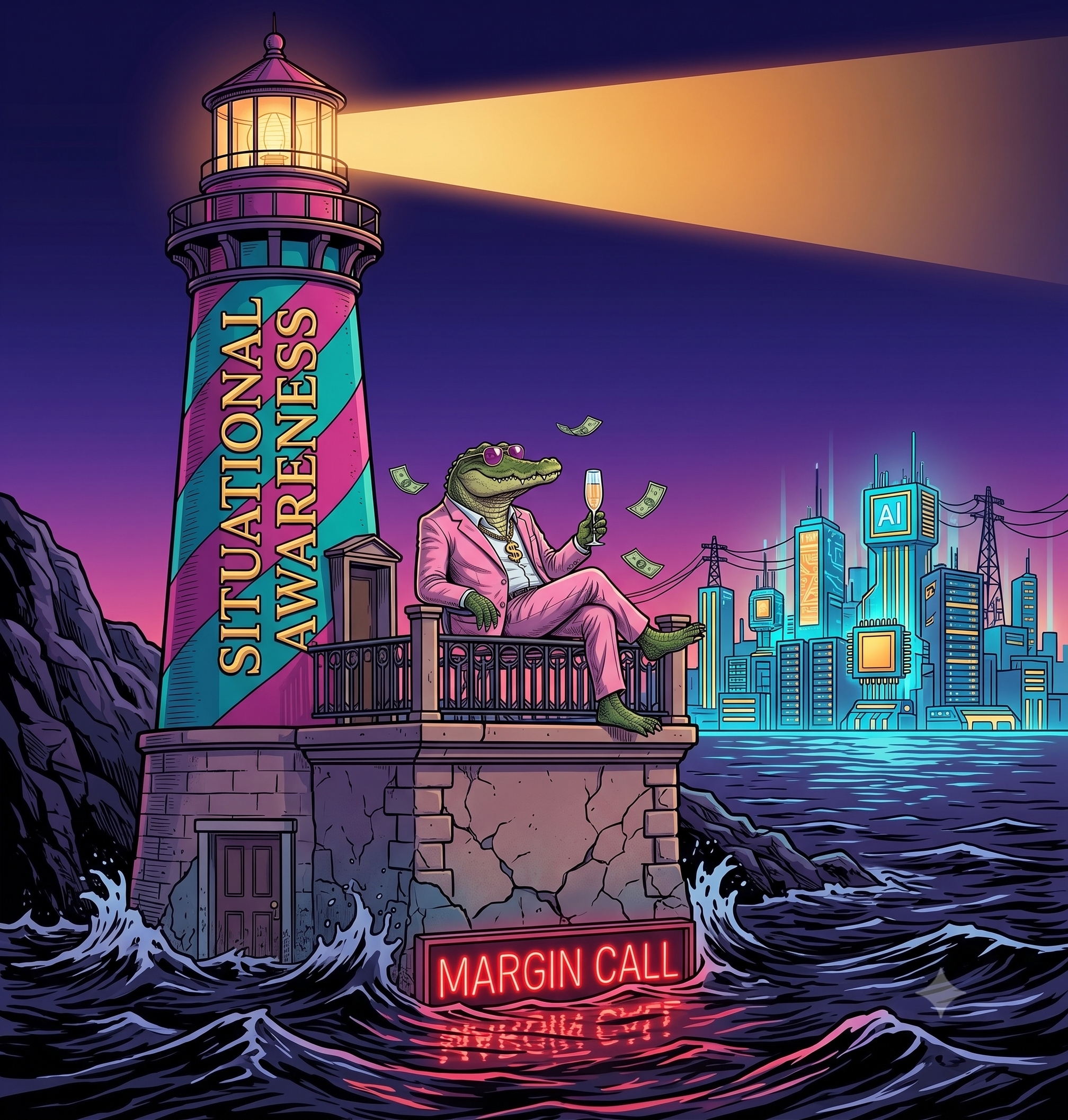
ACT I — THE RÉSUMÉ FROM HELL
2021–2024 · Columbia at 19, FTX, OpenAI, and the door.
Let's start with a résumé. Sonny has read a lot of résumés from his desk in Miami — most of them from people asking for money, a few from people asking for representation, one memorable one from a man who wanted to sue a seagull. But he has never read a résumé quite like Leopold Aschenbrenner's, because Aschenbrenner's résumé has a pattern, and the pattern is this: every institution he touches catches fire shortly after he leaves it.
He was born in Germany, to two physician parents, and he was, by every available account, a genuine prodigy. Not "prodigy" in the LinkedIn sense where a man calls himself a prodigy because he learned Excel. Prodigy in the actual sense. He enrolled at Columbia at fifteen. He graduated in 2021 at nineteen, as valedictorian of Columbia College, with a double major in economics and mathematics-statistics. An economics professor wrote, in the university's own valedictorian announcement, that his record of scholarship "exceeds that of any student in the department in the last 20 years." [Fortune]
This is the part of the story where Sonny wants to be clear: Aschenbrenner is not stupid. This is not a story about a stupid person. Nothing that follows can be explained by stupidity. That is precisely what makes it a good story. Stupid people lose money in boring ways. Brilliant people lose money in ways that get written up in the Wall Street Journal.
The First Fire: FTX
In February 2022, Aschenbrenner joined the FTX Future Fund — the philanthropic arm of Sam Bankman-Fried's cryptocurrency exchange. He was a research analyst on a five-person team. One of his colleagues on that team was a woman named Avital Balwit. Hold that name. It will come back. It always comes back.
The FTX Future Fund was, on paper, a serious operation — hundreds of millions of dollars committed to "effective altruism" grants, to pandemic prevention, to AI safety research, to the general project of using Sam Bankman-Fried's fortune to improve the long-term future of humanity. The problem, which the entire world learned in November 2022, was that Sam Bankman-Fried's fortune was substantially other people's money, and it was substantially gone.
On November 10, 2022 — one day before FTX filed for bankruptcy — Aschenbrenner and the entire Future Fund team resigned. They published a statement condemning FTX's leadership. [EA Forum] The timing was, and Sonny means this as the highest professional compliment, immaculate. To resign from a company one day before it declares bankruptcy is not luck. Luck is winning a raffle. Resigning the day before the bankruptcy is situational awareness. It is, in fact, the single best demonstration of situational awareness in this entire story — and it happened at the beginning, before he'd built a brand around the phrase.
There is no evidence Aschenbrenner did anything wrong at FTX. There is no evidence he profited from the fraud or knew about it. The committed grants simply went unhonored, like everything else FTX touched. He walked away clean. First institution, first fire, zero burns. A perfect record. It would not last.
The Second Fire: OpenAI
In 2023, Aschenbrenner joined OpenAI — specifically the newly formed "Superalignment" team, co-led by Ilya Sutskever and Jan Leike, whose job was to figure out how to control AI systems more capable than humans. This was, at the time, one of the most prestigious research postings in the entire field. He co-authored a paper called "Weak-to-Strong Generalization." He was, at 22, inside the room where the future was allegedly being built.
He lasted about a year.
In April 2024, OpenAI fired him. [The Information] And here the story splits into two versions, the way these stories always do.
OpenAI's version: he leaked confidential information.
Aschenbrenner's version, which he laid out at length on the Dwarkesh Patel podcast on June 4, 2024: the "leak" was a brainstorming document about AI preparedness and safety, which he shared with three external researchers for feedback, and which he says contained nothing confidential. He argues the real reason was a memo he had written to OpenAI's board.
The Memo
The memo is the interesting part, because the memo is about security. After a 2023 breach in which a hacker accessed OpenAI's internal messaging systems, Aschenbrenner wrote to the board arguing that OpenAI's security was — his words — "egregiously insufficient to protect against the theft of model weights or key algorithmic secrets from foreign actors," naming China specifically. [Dwarkesh] He says HR told him worrying about Chinese espionage was "racist and unconstructive," gave him a warning, and that he was later told the memo was a major factor in his firing. OpenAI says the security concerns "did not lead to his separation."
Sonny is not here to adjudicate who was right about OpenAI's security. Sonny is here to note something else. Aschenbrenner was fired, by his own telling, for being too concerned about risk. For raising the alarm too loudly. For being the man in the room who kept saying this is not safe, this is not secure, we are exposed.
Remember that. In eighteen months, this same man will run a hedge fund at four-hundred-percent leverage with no meaningful risk management and blow up 67% in a month. The safety researcher who was too worried about OpenAI's exposure did not, it turns out, apply the same paranoia to his own.
"Let the record show: at OpenAI, he was right. A former OpenAI safety researcher, Scott Aaronson, told CNBC he was 'sorry when he got pushed out because of sharing information in a way leadership didn't approve of,' and that it 'sounded like he was trying to do the right thing.' [CNBC] The kid raised a real alarm about real security gaps and got shown the door for it. Sonny has no quarrel with that Leopold. Sonny's quarrel is with the one who took the word 'exposure' — the exact thing he warned OpenAI about — and built a $45 billion pile of it two years later."
One more thing about the way he left, because it detonates later. When he departed OpenAI, Aschenbrenner refused to sign the company's non-disparagement agreement — the kind that lets you keep your vested equity in exchange for your silence. He walked away from what he described as roughly a million dollars rather than sign it, reportedly summarizing the choice in three words: freedom is priceless. [Dwarkesh] Hold that phrase too. Sonny is collecting phrases in this story, and every single one of them comes back.
There is one more detail from this period that Sonny cannot, in good conscience, leave out, because it is the funniest single fact in the entire dossier. According to Fortune's October 2025 profile, at a holiday party, Aschenbrenner told the then-CEO of Scale AI, Alexandr Wang, how many GPUs OpenAI had — "just straight out in the open." A former colleague described him as "a bit abrasive." [Fortune]
Sit with that. The man who wrote a formal memo to the board about foreign actors stealing OpenAI's secrets, the man later fired for allegedly leaking information, the man whose entire OpenAI narrative is I was the responsible one about security — casually announced OpenAI's GPU count to a rival CEO at a Christmas party. The call was coming from inside the house. The house was him.
ACT II — THE PROPHET
June 2024 · 165 pages, one viral essay, and Ivanka Trump's endorsement.
Situational Awareness: The Decade Ahead
Two months after OpenAI fired him, on June 4, 2024, Aschenbrenner self-published a 165-page essay titled "Situational Awareness: The Decade Ahead." He put it on a website. He did not have a publisher, a PR firm, or a marketing budget. He had a thesis and a title, and it turned out the thesis and the title were worth more than any of those other things. [Essay]
The essay's core argument, compressed: artificial general intelligence is coming much faster than most people think — plausibly by 2027 — and its arrival will trigger an "intelligence explosion" and an unprecedented, world-reshaping build-out of physical infrastructure. Chips. Memory. Data centers. Power. He predicted a "trillion-dollar cluster" consuming more than 20% of US electricity production. He predicted AI investment exceeding a trillion dollars a year. He framed the whole thing as a national security emergency: the United States must beat China, and the government should run a Manhattan-Project-style effort he called, simply, "The Project."
The essay went off like a bomb in Silicon Valley. Tech founders circulated it with the urgency usually reserved for hot term sheets. Policymakers passed it around like a classified intelligence assessment. Scott Aaronson called it "one of the most extraordinary documents I've ever read." And in September 2024, Ivanka Trump posted it on X, writing that it predicted AGI by 2027 and that "this is an excellent and important read." [Ivanka/X]
The New York Post would later call him "the Nostradamus of AI." [Wikipedia]
Now, Sonny wants to give the man his due, because a satirical journalism site that only mocks is a cheap thing, and Sonny is not a cheap thing. Sonny is an expensive thing with a chain. So let the record reflect: the thesis was largely right.
An independent analysis of the essay's predictions found that on the concrete, physical, countable claims — the chips, the data centers, the hundreds of billions in hyperscaler capex, the emergence of power as the binding constraint on AI — Aschenbrenner was strikingly accurate. Not vaguely accurate. Specifically accurate. He looked at 2024 and described 2026 better than almost anyone else looking at 2024. [Dubach]
What he got wrong is the part Sonny wants you to hold onto, because it is the whole moral of the story. The same analysis found that the predictions which failed were the ones about human behavior [Dubach]: that the AI labs would voluntarily merge, that Congress would appropriate trillions, that a coalition of democracies would coordinate, that the US government would nationalize the effort. The machines did what he said. The people did not.
He understood silicon perfectly and human beings not at all. This is a common condition among brilliant young men, and it is usually harmless, and in his case it was about to cost roughly thirty-five billion dollars. Because the thing that would eventually destroy his fund was not a wrong bet on technology. It was a wrong bet on how people behave under pressure — specifically, how prime brokers behave when the collateral drops. He predicted the machines. He got margin-called by the humans.
ACT III — THE FUND
2024–June 2026 · From a viral PDF to a thousand percent.
The Essay Becomes a Fund
Here is where the story does something genuinely audacious. Most people who write a viral essay start a Substack. Aschenbrenner started a hedge fund. And — this is the detail Sonny keeps returning to, because it is so perfect it feels scripted — he named the fund after the essay. Situational Awareness LP. The essay was the pitch deck. The title was the brand. The thesis was the strategy. Write the prophecy, then open a fund to bet on the prophecy, then name the fund after the prophecy.
The money came fast, and it came from serious people. The named backers include Patrick and John Collison, the billionaire brothers who founded Stripe; Nat Friedman, former CEO of GitHub; Daniel Gross, the investor and entrepreneur; and, added later, the elite quantitative trading firm Jane Street. [Fortune] His director of research was Carl Shulman. Regulatory filings suggest a team of roughly four investment professionals — four people — running what would become billions of dollars.
A note on precision, because Sonny promised to be precise and precision is what separates journalism from a group chat. You will see the figure "$225 million" cited as the fund's initial capital. That number appears widely in the trade press but not in the marquee Fortune or Wall Street Journal profiles, which use vaguer language — "several hundred million," and, by late 2025, "more than $1.5 billion." So treat "$225 million" as reported-but-secondary. The honest summary is: he started with hundreds of millions and, within about a year, was running well over a billion.
A Thousand Percent
And then it worked. God, did it work.
Up 439% for the year, by the end of June 2026. Over a thousand percent cumulative since he'd started. [CNBC] These are not hedge fund returns. Hedge fund returns are 8%, 12%, a good year is 20%. These are lottery-ticket returns delivered with the confidence of a physics equation. The AI infrastructure thesis from the essay was playing out in real markets, and Aschenbrenner had bet the thesis with both hands, and the thesis was paying.
By the start of July 2026, the fund's exposure peaked at a figure CNBC reported as $45 billion. [CNBC] He was 24 years old. Two years earlier he had been unemployed, freshly fired from OpenAI, typing a PDF. Now he was, on paper, one of the most successful young investors in the history of the industry, and Silicon Valley treated him — Fortune's word — as a "prophet."
The Leverage
But that $45 billion number needs a footnote, and the footnote is the entire story.
The $45 billion was not investor money. The $45 billion was exposure — the gross size of the fund's positions, inflated by borrowing. The Wall Street Journal reported the fund's actual assets under management at roughly $20 billion, and its leverage at three to four times. CNBC put it at "up to 400%." [CNBC] Which means: for every dollar of real capital, the fund controlled three or four dollars of AI stocks.
Leverage is a wonderful thing on the way up. It is the reason a correct thesis produced not a respectable 40% return but a delirious 439%. Every dollar the market moved in his favor, he collected three or four times. The borrowing is why the ascent was vertical.
Leverage is a different thing on the way down. It does not politely reverse. It compounds against you, and — the crucial part — it takes the timing out of your hands. An unleveraged investor who is right about the long run can simply wait out a bad month. A four-times-leveraged investor does not get to wait, because when the collateral drops far enough, the broker makes the decision for him. The broker calls. And the broker does not care about your thesis. The broker cares about the collateral.
The portfolio, per the fund's Q1 2026 regulatory filing, was a concentrated bet on exactly the names from the essay: long positions in Bloom Energy (power), SanDisk (memory), CoreWeave (data centers), and a cluster of bitcoin-miners-turned-AI-hosts like IREN, Core Scientific, and Applied Digital — offset by billions of dollars of put options betting against laggard sectors, including software names. [SEC 13F] Long the future. Short the past. Levered four to one. It was, as a piece of thesis expression, elegant. It was, as a piece of risk management, a lit match in a fireworks warehouse.
ACT IV — THE BLOW-UP
July 2026 · Thirty-one days, minus sixty-seven percent, one wedding.
The Rout
In July 2026, the AI trade cracked.
It was not a crash of the whole market so much as a violent correction in exactly the corner of the market where Aschenbrenner had concentrated everything. The AI infrastructure names — the chips, the memory makers, the data-center hosts, the power plays — sold off hard. SK Hynix, CoreWeave, Nebius, SanDisk, Micron, Bloom Energy: several of them down more than 30% in the month. The Nasdaq 100 fell more than 10%. [CNBC] And, adding a second wound, the software sector he had shorted rallied — meaning his puts bled money at the exact moment his longs were collapsing. Both sides of the elegant trade caught fire at once.
For an unleveraged fund, this would have been a painful month and a footnote. For a fund levered three-to-four times, it was an extinction event in slow motion, and then in fast motion.
As the collateral fell, the prime brokers — Goldman Sachs, JPMorgan, and Bank of America — did what prime brokers do. They issued margin calls. [CNBC] They asked for more collateral against the borrowed exposure. And when a four-times-levered book is falling, meeting a margin call means selling into the very decline that triggered it, which pushes prices down further, which triggers the next margin call. The thing feeds on itself.
Aschenbrenner, in his own investor letter, named the phenomenon precisely. He wrote that the dynamics were "essentially similar to a bank run: vulnerability begetting more vulnerability." [Investor letter]
Read that quote again, and remember the name of the fund. The man who titled his life's work "Situational Awareness" — whose entire thesis was that he saw the systemic dynamics other people missed — was, in real time, describing himself getting caught in the most classic systemic dynamic in all of finance. A bank run. The oldest one there is. He saw it perfectly. He was inside it while he saw it.
Minus Sixty-Seven Percent
On July 30, 2026, Aschenbrenner sent his investors a letter. It was first reported by the Wall Street Journal and independently seen by Reuters. It opened with five words:
The fund had lost 67% in July. He wrote that they "came closer to permanent capital impairment than is acceptable to us." He wrote: "I take full responsibility for these events." [Investor letter]
Now, Sonny is going to do the thing Sonny does, which is insist on the precise number even when the precise number is less dramatic, because precision is the whole job. The 67% is a monthly loss. Because the fund had been up so violently earlier in the year, it remained — even after this catastrophe — up roughly 80% year-to-date. [Reuters] Aschenbrenner did not go broke. His investors, if they'd been in from the start, were likely still ahead over the life of the fund. This is not a man who lost everything. This is a man who lost two-thirds of everything in thirty-one days, which is a different and in some ways more spectacular thing, because it required being up enough to have two-thirds to lose.
That is what four-times leverage buys you. A year so good it can survive a month that catastrophic and still show a profit. The leverage giveth, and then, in a single month, the leverage taketh away 67%, and the giving and the taking are the same machine.
ACT V — THE BILL
The fire sale, the lifeboat, and the wedding nobody could reach him for.
The Fire Sale
When you are four-times levered and the margin calls will not stop, you do not get to sell carefully. You get to sell now, to whoever will take the whole book at once, at whatever discount they name. And the person who will take a multi-billion-dollar AI portfolio off your hands in a weekend, at a price that suits him, is Ken Griffin.
Griffin's firm, Citadel, bought the bulk of Situational Awareness's public equity book at more than 10% below market value, in a block trade around July 29-30, first reported by the Wall Street Journal. Griffin personally spoke with Aschenbrenner during the negotiations. [Reuters] The prophet of the AI age sold his positions to the establishment at a discount, under duress, because the establishment had the one thing he didn't: the balance sheet to wait.
And here is the detail that elevates this from a finance story to a Greek one. Citadel already held many of the same AI positions. [TechCrunch] Griffin agreed with the thesis. Citadel was long the AI build-out too. The difference between the fund that nearly died and the firm that bought it at a discount was not the idea. The idea was identical. The difference was that one of them had risk management and the other had a 165-page essay about how right he was.
And here is that phrase coming back, right on schedule. The man who forfeited a million dollars because freedom is priceless spent the next two years building a machine in which, at four-times leverage, a margin desk at Goldman Sachs owned every decision he made. He paid a million for his freedom, then leased it back to his prime brokers for nothing. In July, they collected on the lease.
The Wedding
All of this — the rout, the margin calls, the 67%, the midnight fire sale to Griffin — happened during the weekend of Aschenbrenner's own wedding.
He was getting married to Avital Balwit — yes, the FTX Future Fund colleague; the name Sonny told you to hold — in Carmel, California, the first weekend of August 2026. Multiple outlets, including CNBC, Fortune, and the Journal, reported the wedding and the collapse landing in the same days. [Fortune] One investor, quoted by the Financial Times, described the scene with brutal economy: "Leopold just stopped taking calls." [Futurism/FT] Meanwhile, per the Journal, the Collison brothers — two of his backers — were physically in his offices past midnight while he negotiated with Citadel. [CNBC]
Picture the logistics. A 24-year-old is getting married. His fund is imploding by the hour. His prime brokers are calling for collateral. Ken Griffin is on the phone. His billionaire investors are sitting in his office at midnight. And somewhere in Carmel there is a florist, a caterer, and a fiancée who is herself the chief of staff to the CEO of Anthropic [Fortune] — the very company that is about to become his financial lifeboat. You could not write this. Sonny would not dare write this. Sonny is merely reporting it, with a chain on.
The Lifeboat
The fund did not die. This is important, and Sonny flagged it up top: Situational Awareness LP survived. It was not liquidated. It was not shut down.
What saved it is the richest irony in a story made of ironies. The thing that killed the fund was its public book — the liquid, publicly-traded stocks that had a price every second and could be margin-called. The thing that saved the fund was its private book — chiefly a position worth roughly $5 billion in Anthropic, the AI lab, which nobody could margin-call because it doesn't trade daily. [TechCrunch] The illiquid asset that a normal risk manager might flag as hard to sell turned out to be the only thing the market couldn't rip away from him overnight. He was destroyed by the assets he could sell and rescued by the one he couldn't.
After the dust settled, the fund held roughly $10 billion in assets, deleveraged, shorts closed, running what Aschenbrenner called a "fully-paid-for public book" — which is a poetic way of saying he has finally, at the cost of 67% in a month, discovered the concept of not borrowing four dollars for every one he has. He even reportedly shopped a $3.5 billion slice of the Anthropic stake to Sequoia and Greenoaks [TechCrunch] — trying to sell down the very thing keeping him afloat, because when you are deleveraging in a panic, even the lifeboat gets partially sold for parts. He invited fresh capital. Per Bloomberg, the response was tepid.
And the Anthropic connection has one more layer, because of course it does. FTX — the first fire, the one he walked away from clean — was an early investor in Anthropic. His fiancée is Anthropic's CEO's chief of staff. His fund's survival now depends on Anthropic's valuation. Every road in this man's life, from Sam Bankman-Fried to his own wedding to his fund's lifeboat, runs through the same building in San Francisco. Fortune raised the obvious conflict-of-interest questions in its October 2025 profile. Sonny will simply note that when your fund's largest surviving asset is a company whose CEO's calendar is run by your spouse, you have achieved a level of situational entanglement that no essay could have predicted — least of all one titled "Situational Awareness."
He Is Not the First
Sonny wants to zoom out, because the temptation with a story like this is to treat it as a freak event — a one-off, a fluke, a young man's singular mistake. It is not. It is one of the oldest stories in all of finance, and Aschenbrenner, who read everything, read this too.
LTCM, 1998. A hedge fund with two Nobel laureates on the board and a Ph.D. arbitrage thesis, levered roughly 25-to-1. One Russian default and a liquidity spiral later, the Federal Reserve had to organize a $3.6 billion bank rescue. The smartest men in the room. Fatal leverage.
Archegos, 2021. Bill Hwang used swaps to build over $100 billion of hidden, concentrated exposure. When one stock dropped, margin calls forced a ~$20 billion liquidation; the banks lost more than $10 billion; Hwang was later convicted of fraud. [SEC] Concentrated. Levered. Gone in days.
Melvin Capital, 2021. Gabe Plotkin's fund was caught short GameStop when Reddit squeezed it, and cratered 53% in a single month. Its rescue came from — note the name — Ken Griffin's Citadel, which led a $2 billion emergency injection. Melvin never recovered and shut down in 2022. See the recurring name: when a leveraged fund detonates, Citadel is the one standing at the crater with a checkbook. Aschenbrenner's 67% month was steeper than Melvin's 53% — except this time Citadel didn't inject capital to save him. It bought his book at a discount and kept the change.
Aschenbrenner is 24 and studied economics at Columbia. He knows these stories cold — every finance student does. The graveyard is clearly marked, the headstones are legible, and every generation still produces one genius certain that the epitaphs describe someone less clever than himself.
The difference — the one mercy in his version — is that LTCM needed a Federal Reserve bailout and Archegos ended in a fraud conviction and a total wipeout. Aschenbrenner got Ken Griffin and a surviving Anthropic stake. He ran the oldest trap in the book and, on the strength of one illiquid private position his fiancée helps administer, walked out of the graveyard still breathing. The Nostradamus of AI did not predict the margin call. But he did, at least, survive it — which is more than the Nobel laureates managed.
What should Leopold be allowed to run next?
"Sonny has watched a lot of smart young men explain to him why the rules of leverage do not apply to them, on account of being right. And Sonny tells every one of them the same thing: being right is the most expensive way to go broke. The idiot who bets wrong loses his money and goes home. The genius who bets right with four-times leverage loses his money in a fire sale to Ken Griffin during his own wedding, and gets a Wall Street Journal article about it. Leverage does not ask whether you are smart. Leverage asks one question — can you post the collateral by Tuesday? — and if the answer is no, your genius is a rounding error and your broker is your boss. Predict the future all you like, kid. Just make sure you own your positions outright, because the market can stay a bank run longer than you can stay solvent. Sonny doesn't lever. Sonny owns his chain outright."
P.S. Leopold — congratulations on the wedding, and Sonny means that sincerely; the timing was cruel and no one should get margin-called at their own reception. Sonny will only note, for the record, that the fund survived, you're still up on the year, and you're 24 — which means this is a bump, not an obituary, and the smartest thing you could possibly do with the next decade is remember exactly how the leverage felt in July. You were right about the machines. Next time, be a little more paranoid about the humans holding your collateral. You used to be good at that. 🐊
📰 Sources
- CNBC — "How Leopold Aschenbrenner built a $45 billion AI hedge fund — and lost most of it in days" (Jul 31, 2026)
- CNBC — "Why Situational Awareness imploded" (Jul 31, 2026)
- CNBC — "Aschenbrenner's hedge fund forced to unwind all public positions" (Jul 30, 2026)
- Reuters — "Citadel buys most of Situational's stock holdings" (Jul 30, 2026)
- TechCrunch — "…still has its Anthropic shares" (Jul 30, 2026)
- Business Insider / AOL — full text of Aschenbrenner's investor letter (Jul 31, 2026)
- Fortune — "The improbable rise of a 23-year-old ex-OpenAI researcher" (Oct 8, 2025)
- Leopold Aschenbrenner — "Situational Awareness: The Decade Ahead" (essay, Jun 2024)
- Dwarkesh Patel Podcast — Aschenbrenner's account of the OpenAI firing (Jun 4, 2024)
- EA Forum — FTX Future Fund team resignation statement (Nov 10, 2022)
- The Information — OpenAI fires researchers for alleged leaking (Apr 2024)
- TechCrunch — Anthropic raises $65B, nears $1T valuation (May 28, 2026)
- Futurism — "A Prominent AI Investor Is Now Crumbling" (FT "stopped taking calls" quote)
- Quartz — "Situational Awareness collapses after margin calls" (Jul 31, 2026)
- SEC EDGAR — Situational Awareness LP 13F filings
- Philipp Dubach — "Aschenbrenner's Receipts" (essay prediction scorecard)
- Ivanka Trump on X — endorsement of the essay (Sep 2024)
- Wikipedia — Leopold Aschenbrenner (biography, timeline)
- SEC — Archegos / Bill Hwang charges (leverage-collapse comparison)
Note on figures: the "$45 billion" peak is reported by CNBC as gross/leveraged exposure; the Wall Street Journal reported ~$20 billion in actual AUM at 3–4× leverage. The −67% is a monthly figure from Aschenbrenner's own July 30 investor letter; the fund remained up ~80% year-to-date. The core collapse — margin calls, the Citadel block trade below market, the ~$10B surviving assets — was first reported by the Wall Street Journal, Financial Times and Bloomberg (paywalled) and corroborated by the open sources above. All commentary is editorial opinion.