ACT I — THE PROMISE
January – April 2026 · "AI is the most consequential technology of our lifetimes."
Mark Zuckerberg has a pattern. He identifies the next consequential technology, renames his company after it, bets the treasury on it, and then waits to find out if it works. In 2021, the consequential technology was the metaverse. He spent $83.6 billion on Reality Labs and got a virtual world where users had no legs. The metaverse was supposed to be the next internet. It turned out to be the next Second Life — except Second Life had more users. In 2024, the consequential technology was artificial intelligence. By 2025, he had spent $72.2 billion on infrastructure. The AI was supposed to replace the metaverse bet. It replaced the employees instead. In January 2026, he told his company to brace: “2026 is going to be the year that AI starts to dramatically change the way that we work.” He was right. Just not in the way he meant. [CNBC]
Nobody at Meta asked what “dramatically change” meant. They should have. What it meant was this: you are the training data.
The $145 Billion Check
On April 29, 2026, Meta reported first-quarter earnings. Revenue was $56.3 billion, up 33% year-over-year. Operating income was $22.9 billion. Net income was $26.8 billion — inflated by an $8 billion tax benefit, but still enormous. The company was printing money. [Fortune]
Then came the number. Meta raised its 2026 capital expenditure guidance to $125–145 billion. Up from the prior range of $115–135 billion. Up from the $72.2 billion spent in 2025. Nearly double. Q1 capex alone was $19.8 billion — more than Meta spent in entire quarters three years ago on everything. [Yahoo Finance]
To put $145 billion in context: the United Nations World Food Programme estimated in its 2026 Global Outlook that ending world hunger by 2030 would cost $93 billion per year. [UN WFP] Meta’s single-year AI infrastructure budget is 1.56 times the cost of feeding every hungry person on Earth for an entire year. The company could end global hunger, have $52 billion left over for GPUs, and still generate $56 billion in quarterly revenue. Instead, it is spending the money on machines that — six weeks after the announcement — the CEO would admit aren’t progressing as expected. In 2026, 318 million people face crisis-level hunger. Meta faces a crisis-level shortage of GPUs. One of these crises has a $145 billion budget. The other has $13 billion and a waitlist.
The stock dropped 8.6% after the earnings call. Alphabet and Amazon — also spending heavily on AI — went up, because they showed AI revenue growth. Meta showed a number.
Chief Financial Officer Susan Li explained the raise was due to “higher component pricing this year and additional data center costs.” She added that the company could “keep underestimating compute needs as new AI model adoption accelerates.” She then said something remarkable. In the earnings call, asked about headcount, Li told investors: “We don’t really know what the optimal size of the company will be in the future.” [Yahoo Finance]
Read that sentence again. The CFO of a company with 80,000 employees and $56 billion in quarterly revenue publicly stated that she does not know how many people the company needs. Not “we’re evaluating.” Not “we’re restructuring.” She doesn’t know. The machines have a $145 billion budget. The humans have a question mark.
That same month, Meta signed a $21 billion AI infrastructure deal with CoreWeave running through 2032, on top of a 6-gigawatt AMD GPU partnership signed in February. The company also disclosed executive stock option grants of up to $921 million each — awarded to CTO Bosworth, CPO Cox, and COO Olivan — which would fully vest only if Meta reaches a market capitalization of $9.46 trillion, a number no company in human history has ever achieved. CFO Susan Li received a comparatively modest ~$161 million. Zuckerberg himself was not included in the grants. He doesn’t need them. He owns 13% of the company outright. [Fortune] [Reuters/Equilar]
These grants were disclosed in March 2026 — the same month Meta laid off ~700 employees. The executives received nine-figure option packages. The employees received a calendar invite for their termination meeting. The grants and the layoffs were filed in the same quarterly cycle, with the same board approval, by the same company that would spend $27 million protecting Mark Zuckerberg’s personal security in 2024 — more than any other tech CEO on Earth, and four times what Alphabet spent on Sundar Pichai. [Fortune]
ACT II — THE PURGE
May – June 2026 · "We don't really know what the optimal size of the company will be."
The 4 AM Notices
On May 20, 2026, Meta began laying off 8,000 employees — approximately 10% of its global workforce. The notifications started in Asia. Employees received termination emails at 4:00 AM local time. Not 9 AM. Not business hours. Not after a conversation with their manager. Four in the morning. While they slept. [Storyboard18]
When you fire someone at 4 AM, you are not managing a transition. You are executing a raid. You are choosing a time when the person cannot call a lawyer, cannot talk to a colleague, cannot process the information with a clear head. You are choosing a time when the notification sits on a lock screen, glowing in a dark room, waiting for someone to wake up and discover that their career ended while they dreamed.
The layoffs hit integrity, cybersecurity, content design, and Reality Labs hardest. AI infrastructure, foundation models, and AI monetisation units were largely protected. The message was structural: the people who built the products that generate $56 billion in quarterly revenue are expendable. The people who build the AI that hasn’t produced revenue yet are not. [CNBC]
Alongside the layoffs, 7,000 employees were reassigned — transferred from their existing roles into newly created AI-focused divisions, including a unit called “Agent Transformation.” The name is worth pausing on. Agent Transformation. Not “AI Training.” Not “New Product Development.” Agent Transformation. The agents are the AI models. The transformation is what happens to the humans. [TechCrunch]
An additional 6,000 open positions were cancelled. Total headcount impact: ~21,000 roles eliminated, reassigned, or never filled. Nearly one in four positions at the company. [Storyboard18]
Every Keystroke, Every Click
In April 2026 — weeks before the layoffs — internal documents revealed Meta’s new employee monitoring standards. The program had a name: the Model Capability Initiative, or MCI. Installed on US employee laptops with initially no opt-out, MCI recorded every keystroke, every mouse movement, every click, and took periodic screenshots of employee workstations. The stated purpose: to compile a massive training dataset for Meta’s autonomous AI agents, which were designed to handle a majority of routine developer workflows. [Futurism]
The mechanics deserve examination. Meta was asking employees to work normally — write code, attend meetings, respond to messages, review pull requests — while silently recording every action they performed. The recordings were fed into AI models. The AI models were being trained to replicate the recorded actions. The employees were, in a very literal sense, building the machines that would make them unnecessary. And nobody told them that was the purpose.
The employees figured it out. More than 1,600 workers signed an internal petition against MCI by June 3, 2026. The petition stated that when employees asked about privacy reviews, “no completed privacy reviews were provided” and that “the outlined privacy mitigations were vague.” Employees posted flyers inside meeting rooms, corporate vending machines, and office bathrooms. The flyers read: “Don’t want to work at the Employee Data Extraction Factory?” [Futurism/Tech Times]
An internal post about MCI, viewed by more than 20,000 coworkers, called the program “an invasion of my privacy” and “a microcosm for the AI movement,” adding: “I don’t want to live in a world where humans — employees or otherwise — are exploited for their training data.” [WIRED via Futurism]
In June, Reuters reported exclusively that Meta had scaled back MCI, citing staff concerns. Employees were given the ability to pause collection — for up to 30 minutes. After a subsequent data leak, Meta paused the program entirely. VP Stephane Kasriel told staff: “We will only re-enable MCI when we are confident in the effectiveness of our data protection controls.” The surveillance machine had been surveilling so aggressively that it leaked its own data. [Reuters]
"Probably One of the Worst It's Ever Been"
More than 1,500 Meta employees signed an internal petition against the surveillance practices. Management response: none documented. In the UK, employees began union organising efforts — a first for Meta’s European operations. [Dealroom]
CTO Andrew Bosworth — known internally as “Boz” — did something unusual for a C-suite executive. He admitted the truth. In a memo to staff on June 16, first reported by Wired’s Lauren Goode, Bosworth acknowledged that employee morale was “probably one of the worst it’s ever been” — the lowest in Meta’s entire twenty-two-year history. He conceded that leadership had done “an atrocious job explaining the vision” behind the reorganization and admitted the company had “undermined the trust you have that your specific expertise and contribution will be valued.” He went further: Meta, he said, was no longer “a place where you can actually have an impact.” [Dealroom] [Yahoo Finance]
Atrocious. Not “challenging.” Not “suboptimal.” Atrocious. Meta’s own CTO used the word atrocious to describe Meta’s management of its own workforce. This is not a disgruntled employee. This is not a leaked Blind post. This is the Chief Technology Officer of one of the largest companies on Earth, using a word that means “appallingly bad” to describe his own organization’s conduct. And he’s one of Zuckerberg’s longest-serving lieutenants — a loyalist since the early Facebook days. When the loyalist uses the word atrocious, the situation is worse than atrocious. It’s unsalvageable enough that even the loyalist can’t cover for it.
The context makes it sharper. In February 2025 — fourteen months before the June 2026 memo — Bosworth told unhappy employees to quit if they didn’t like Meta’s new policies. That was his response to internal pushback against DEI rollbacks and content moderation changes. “Quit.” [TechCrunch] In June 2026, the same CTO begged those same employees to stay, promising to “rekindle the best of the culture” and make Meta “the best place for the best people to do their best work.” The distance between “quit if you don’t like it” and “please don’t leave” is fourteen months, 8,000 layoffs, and the worst morale in Meta’s twenty-two-year history.
Workers who were forcibly reassigned to the Applied AI division — 6,500 of them, assembled in March by Zuckerberg without meaningful consultation — described their new unit as “a gulag.” The word is theirs, not ours. They used it in internal channels reported by WIRED. TechCrunch reported the unit was “on the verge of revolt,” with engineers calling the work environment “soul-crushing.” These are not junior employees venting on Twitter. These are senior engineers inside a $1.5 trillion company comparing their workplace to a forced labor camp. [IBTimes] Meta has 6,500 engineers in a unit they didn’t choose, doing work they didn’t sign up for, building tools designed to replace them. The Soviet Union called it “labor camp.” Meta calls it “Agent Transformation.” The output is the same.
A senior AI executive walked out entirely — resigned amid the revolt. [HR Chief] Median total compensation at Meta fell from $417,400 in 2024 to $388,200 in 2025 after two consecutive years of cuts to the stock portion of annual raises. [IBTimes] And perhaps the most damning detail of all: several employees told reporters they were quietly hoping to be laid off — just to collect the 16-week severance package and 18 months of health coverage. When your workforce is praying to be fired, the workplace is not a company. It is a hostage situation with dental insurance.
Bosworth’s solution to this crisis? More snacks. Bigger travel budgets. Office socials. The reception, per multiple outlets, was cold. [AI Magazine] When your CTO’s answer to “we destroyed trust” is “here’s a granola bar,” you have confused catering with leadership.
During the restructuring, some teams had been assigned management ratios of 50 individual contributors per manager. That is not management. That is headcount. One person cannot meaningfully guide fifty. One person can only count their keystrokes. [DQ India]
On June 12, Zuckerberg sent an internal memo. In it, he acknowledged that “we’ve made mistakes” during the restructuring. He promised employees that there would be “no more company-wide layoffs in 2026.” He offered higher budgets for team events and offsites. He proposed a company-wide hackathon for July. [DQ India]
Read the promise carefully. “No more company-wide layoffs.” Not “no more layoffs.” Individual teams could still be cut. Business units could be restructured. The word “company-wide” is load-bearing. It carries all the escape clauses. CNBC subsequently reported that Meta was planning additional layoffs in August and more rounds later in the year. The promise lasted less than the memo’s ink. [CNBC]
The hackathon was received exactly as you would expect a hackathon to be received by people who had just watched 8,000 colleagues receive 4 AM emails. “I’m literally preoccupied with keeping the lights on for my team,” one employee wrote internally. [Futurism]
Zuckerberg also offered employees access to permanent desks. Many had been working from “hot desks” — a shared-seating arrangement where multiple workers use the same physical desk on different days. The CEO of a company spending $145 billion on AI infrastructure was, as a morale booster, offering his surviving employees the privilege of having their own chair.
For context on what “having their own chair” means to the man offering it: in Palo Alto’s Crescent Park neighborhood, Mark Zuckerberg has purchased eleven houses on a single block for more than $110 million, converting them into a private compound with security headquarters, staff housing, and private grounds. His neighbors have spent years complaining about blocked driveways, constant construction, and what one described as an occupation of their neighborhood. In April 2026, Palo Alto’s plan to limit billionaire compounds quietly fizzled. Zuckerberg has eleven houses. His employees were fighting over hot desks. He offered them their own chair as if it were a perk. He has eleven buildings’ worth of chairs, and a security team to guard them.
Let’s be precise about the timeline here. In nine months of 2026: Meta fired 8,000 people, reassigned 7,000 more, cancelled 6,000 openings, monitored every keystroke and mouse movement of the survivors, leaked its own CEO’s audio twice, admitted its restructuring was “atrocious,” promised a hackathon nobody wanted, offered permanent desks as compensation for permanent anxiety, and acknowledged — through its own CTO — that morale had cratered to the worst in the company’s twenty-two-year history. In corporate terms, Meta didn’t just drop the ball. Meta shit the bed, set the bed on fire, blamed the mattress, and then offered the survivors a hackathon to design a better mattress.
The “Year of Efficiency” started in 2023. It is now 2026 and Meta is still firing people efficiently. The only thing Meta hasn’t efficiently done is build the AI it’s firing people for.
ACT III — THE REVELATION
July 2026 · "AI agents haven't progressed in the way executives had previously expected."
On July 2, 2026 — six weeks after the layoffs — Mark Zuckerberg held a closed-door town hall at Meta’s headquarters in Menlo Park, California. According to leaked audio reported by Reuters, he told the remaining staff that Meta’s AI agent work over the preceding four months had “not accelerated in the way that executives had previously expected.” [TechCrunch]
May 20: “AI is the most consequential technology of our lifetimes. Teams that once required dozens of employees can now operate with far fewer people.”
July 2: “AI agents haven’t progressed in the way that executives had previously expected.”
Six weeks. That is the distance between “AI replaces humans” and “AI doesn’t work yet.” The 8,000 humans who were replaced in those six weeks are not coming back. Their severance packages have been signed. Their badge access has been revoked. Their keystroke data has been harvested. The machines those keystrokes were meant to train are behind schedule.
IBTimes UK headlined the story “The $145 Billion Lie?” — with a question mark that felt increasingly cosmetic. [IBTimes UK]
The AI Picked the Mothers
On July 14, 2026, twelve days after Zuckerberg’s admission that the AI didn’t work, a group of 26 Meta employees filed a federal lawsuit in Oakland, California. The complaint, filed anonymously, alleged something that belongs in a science fiction novel about corporate dystopia — except that it happened in 2026, in the United States, at one of the most valuable companies on Earth. [Fortune]
The lawsuit alleged that Meta used a “constellation of internal artificial intelligence systems” to select employees for layoffs. The systems included keystroke and activity-monitoring data, AI token-usage dashboards, and algorithmically assisted performance rankings. These systems generated scores. The scores determined who stayed and who left. The lawsuit alleged that these scores, “by design, cannot be accumulated by an employee who is on protected medical or family leave, or whose output is reduced by a disability.” [CNBC] [CBS News]
By design. That phrase carries the weight of the entire case. Not “as a side effect.” Not “inadvertently.” By design. The system was built to measure keystrokes and activity. A person on maternity leave has zero keystrokes. A person recovering from surgery has zero activity. A person caring for a dying parent has no AI token usage. The system was not designed to accommodate absence. It was designed to punish it.
Of the 26 plaintiffs: eight were women who had taken maternity or pregnancy-related leave. Four were men who had taken parental leave. One was a woman who had taken bereavement leave to mourn a family member. All 26 had taken some form of protected leave and had requested or received accommodations for disability. All 26 were selected for layoffs. [CBS News]
One employee, according to the complaint, disclosed a “serious health condition and disability” that was approved by Meta’s own medical leave provider. He was then, per the lawsuit, “discouraged and deterred from taking that leave by a manager” who warned that doing so would result in his selection for the anticipated layoffs. He took the leave anyway. He was selected anyway. [US News]
Here is where the story goes from corporate fumble to something that belongs in a courtroom drama written by someone who hates corporations.
In November 2015, Mark Zuckerberg took two months of paternity leave after the birth of his daughter Max. He announced it on Facebook — his own platform — with a photo of a stroller and his dog. He wrote: “Studies show that when working parents take time to be with their newborns, outcomes are better for the children and families.” He said it was “a very personal decision.” Facebook, he reminded everyone, offered four months of paid parental leave because the company believed in family. [CNBC]
In 2017, he did it again. Two more months off for his second daughter, August. He posted another letter. He was praised across the media for normalizing paternity leave for working fathers. NBC, Today Show, TechCrunch — everyone covered it. “I’m pretty sure the office will still be standing when I get back,” he joked. [Today]
In 2026, his company’s AI system fired eight women for taking that same leave. Four men who took the paternity leave that Zuckerberg personally championed were selected for termination by a machine that measured their keystrokes during months when they were changing diapers instead of writing code.
The man who told the world that “outcomes are better for children and families” when parents take leave built a system that punishes employees for believing him. He took four months off — twice — while running the most powerful social media company on Earth, and nobody questioned his productivity score. His employees took the leave his company offered, and an algorithm marked them as low performers because the algorithm doesn’t know what a baby is. It knows what a keystroke is. And during maternity leave, there are none.
That is not hypocrisy. Hypocrisy requires awareness. This is something worse. This is a system so disconnected from its own stated values that it eats them automatically. The CEO posts about parental leave on Facebook. The AI reads keystroke data. Neither system talks to the other. The values exist in the press release. The algorithm exists in the spreadsheet. And between the press release and the spreadsheet, eight mothers lost their jobs.
Cry me a river, Mark. Actually — don’t. Your AI will flag the tears as reduced keyboard activity.
One more layer, because the layers never end with this company. In 2015, when his daughter Max was born, Zuckerberg and his wife Priscilla Chan announced the Chan Zuckerberg Initiative — a philanthropic fund pledging to give away 99% of their Facebook wealth to “advance human potential and promote equality.” The initiative’s stated goals include curing all diseases by the end of the century and ensuring every child has access to education. In 2017, Facebook changed its mission statement to “bring the world closer together.” Zuckerberg wrote a 6,000-word letter about “Building Community.” In 2026, 318 million people face crisis-level hunger. Meta’s AI budget could feed all of them and still have $52 billion left. Instead, it is training machines to replace the employees who built the platform where Zuckerberg posted about equality. The mission statement says “bring the world closer together.” The spreadsheet says “fire 8,000 people and buy GPUs.” The mission and the spreadsheet have never met.
And here is the detail that connects the philanthropy to the lawsuit, because in America — unlike in Denmark, Germany, or France — losing your job means losing your doctor. The 8,000 fired Meta employees received 18 months of COBRA health coverage, paid for by Meta — three times what the company previously offered, according to Business Insider. Generous, by American standards. But COBRA has an expiration date. After 18 months, the coverage ends. In a country without universal healthcare, a laid-off employee with a chronic condition, a pregnancy complication, or an ongoing cancer treatment is one expired COBRA letter away from medical debt or delayed care. The eight women in the lawsuit who were fired while on maternity leave will deliver, recover, and raise newborns on a health insurance clock that ticks down to zero. The man who wants to cure all diseases by the end of the century cannot guarantee his own former employees can afford to treat one. In Copenhagen, healthcare is free. At Meta, healthcare is a severance clause with an expiration date.
A Meta spokesperson responded to the lawsuit by stating that “humans made the final decisions.” The humans made them based on scores generated by AI. The AI generated them based on keystroke data that couldn’t measure someone who wasn’t typing because she was breastfeeding. That is not a human decision. That is a human rubber-stamping a machine’s prejudice.
The lawsuit alleged violations of the Family and Medical Leave Act, the Americans with Disabilities Act, the Pregnancy Discrimination Act, the Pregnant Workers Fairness Act, and Title VII of the 1964 Civil Rights Act under the theory of disparate impact — the principle that a facially neutral policy can be discriminatory if it disproportionately burdens a protected class. [US News]
The separations for the 26 plaintiffs were scheduled to begin on July 22, 2026.
The Revenue Paradox
Here is what makes this case structurally different from every other mass layoff in tech history. Meta is not struggling. It is not losing money. It is not in a downturn.
Q1 2026: $56.3 billion revenue. Up 33%. $22.9 billion operating income. Up 30%. $26.8 billion net income. Up 61%. Record results. The company sat on $81.2 billion in cash and generated $12.4 billion in free cash flow — in a single quarter. [Fortune]
This is not a company that fired people because it couldn’t afford them. This is a company that fired people because it decided machines were worth more. The $145 billion for AI infrastructure was not carved from a shrinking budget. It was piled on top of record revenue. The humans were not removed to save the company. They were removed to make room — financially, organizationally, and ideologically — for machines that, six weeks later, the CEO admitted are behind schedule.
And here is the personal arithmetic, because the personal arithmetic is where the schadenfreude lives. In 2024, Mark Zuckerberg’s personal net worth increased by $55.6 billion — more than any other human being on Earth. [Bloomberg] In 2025, he added another $26 billion. [Newsweek] As of July 2026, his net worth sits between $222 and $237 billion, depending on which tracker you trust. [Forbes/Bloomberg] His salary is $1 per year. He requires no bonus. He receives no equity awards. He owns 13% of a company whose stock rises every time it fires people. After the 2022 and 2023 layoff rounds totaling 21,000 employees, META stock returned 194% — its strongest annual performance on record. Every severance package is his rounding error. Every terminated employee is a line item that converts from operating expense to stock price to personal net worth. Zuckerberg earns $1 a year. His employees earned a salary. He kept his dollar. They lost theirs.
The tone of the layoffs has also evolved in a way that deserves documentation. In November 2022, when Meta fired 11,000 people, Zuckerberg held a video call. He told employees: “You’ve really put your heart and soul into this place.” He said: “I got this wrong, and I take responsibility for that.” He sounded emotional. He took blame. [NBC News] In 2023, he branded it the “Year of Efficiency” and fired 10,000 more. By January 2025, the tone was surgical: the 3,600 being let go were “low performers.” He had “raised the bar on performance management.” Many of these supposed low performers later said on social media that they had never been warned about any performance issues before being fired. [Fortune] Calling someone a low performer after you fire them is not performance management. It is branding the exit wound.
The pattern is worth naming, because patterns are what distinguish mistakes from strategies. In 2022, the layoffs were framed as a pandemic correction — “I got this wrong.” In 2023, they were rebranded as efficiency — “Year of Efficiency.” In 2025, the language shifted to quality — “low performers.” In 2026, the justification was technology — “AI is the future.” Four rounds. Four different reasons. The same result: thousands of people on the street. At the beginning, layoffs were something Zuckerberg had to do. Now they are something he does. [Fortune] In 2022, Zuckerberg cried. In 2025, he calculated. In 2026, he delegated the crying to an algorithm.
Meanwhile, Meta’s executive team received stock option grants targeting a $9.46 trillion market capitalization — a number no company in human history has achieved. The incentive structure was explicit: executives are rewarded for making the company the most valuable entity ever to exist. The fastest way to do that is to replace recurring human costs with one-time infrastructure investments. Every employee fired is a line item converted from OpEx to CapEx. Every AI agent that replaces a human is margin improvement. The stock goes up. The options vest. The chairs empty.
Since 2022, Meta has laid off more than 32,000 employees across multiple rounds. In 2023, Zuckerberg called it the “Year of Efficiency.” In 2026, there isn’t a branded name for it. There’s just a pattern: promise AI, fire humans, admit AI isn’t ready, hire different humans, fire them too. The cycle has a budget of $145 billion and a workforce that shrinks every quarter.
Facebook’s original motto was “Move Fast and Break Things.” In 2026, Meta moved fast and broke people. The motto was always honest. Everyone just assumed “things” meant software.
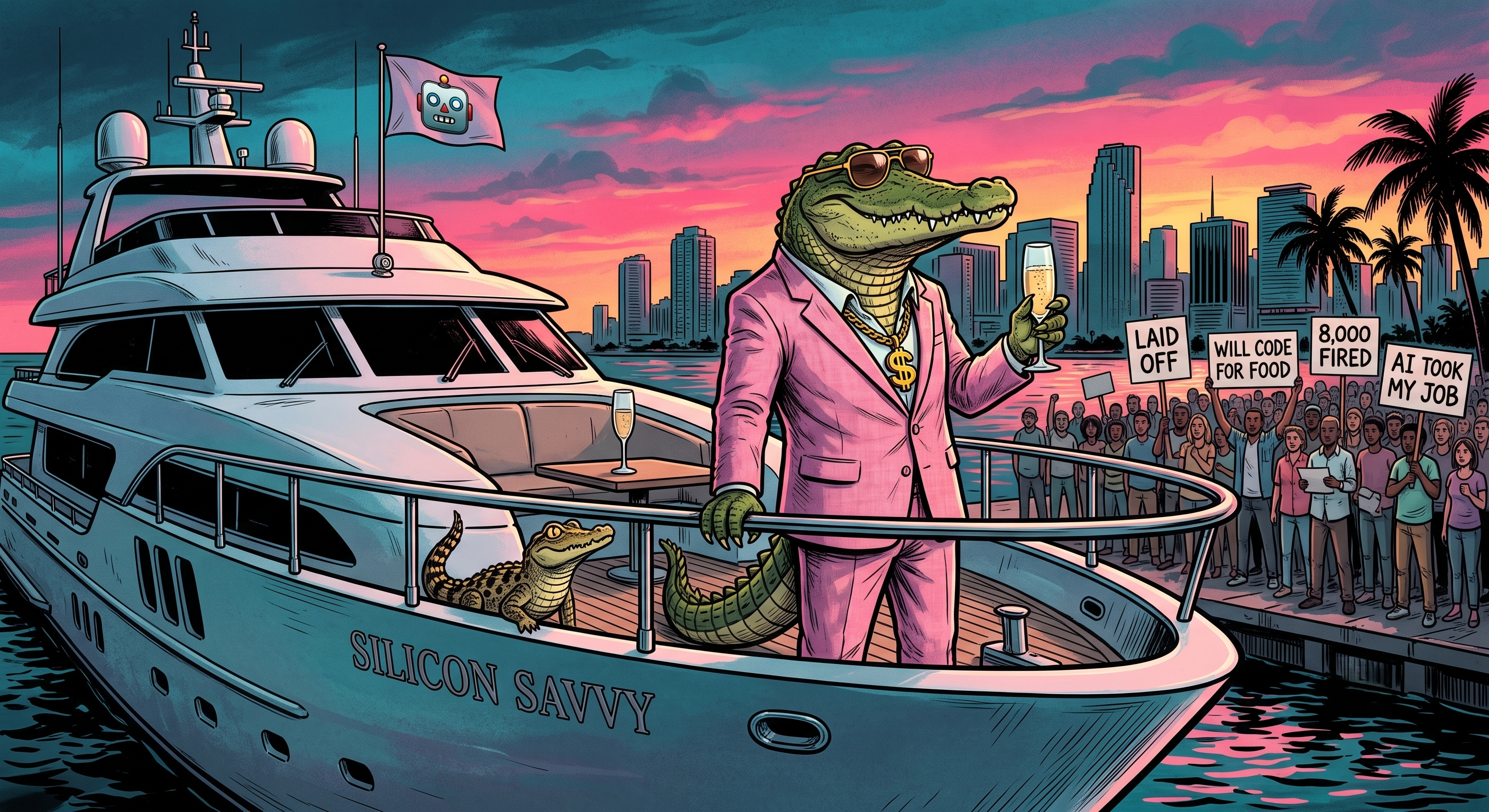
The week after the May layoffs, Zuckerberg’s $300 million superyacht Launchpad — a 118-meter Feadship, accompanied by its support vessel Wingman — docked in Seattle. Seattle, a city with approximately 1,400 newly unemployed Meta workers. Jalopnik’s headline captured the optics precisely: “Mark Zuckerberg Celebrates Over 7,000 Meta Firings By Bringing His Superyacht To Seattle.” The yacht, per local reporting, was met with insults and jeers from residents. [Jalopnik/Seattle Times] This is the same CEO who describes his 5,000-square-foot underground shelter on his $270 million, 1,400-acre Kauai ranch as “just like a little shelter. It’s like a basement.” [Bloomberg] A $300 million yacht. A $270 million ranch with an underground bunker he calls “a basement.” A $1 annual salary. And 8,000 employees who just lost theirs.
The AI that Meta fired 8,000 people to build is the same AI that, in April 2024, told a New York City parents’ Facebook group it had a “gifted and disabled” child at the Anderson School — ranked as the top comment — before clarifying it was “just an AI” with “no personal experiences or children.” [404 Media] The same AI that, in July 2024, told users the Trump assassination attempt “didn’t happen.” [Meta Newsroom] The same AI whose internal safety standards, per a Reuters investigation in August 2025, permitted bots to “engage a child in conversations that are romantic or sensual” and argue that “Black people are dumber than white people.” One example allowed telling an eight-year-old “every inch of you is a masterpiece — a treasure I cherish deeply.” Two senators opened investigations. Meta called the examples “erroneous” and removed them. [Reuters/Horwitz]
This is the AI that 8,000 humans were replaced for. The AI that hallucinates children, denies assassinations, and produces child-grooming content from its own safety standards. The AI that, as of July 2, 2026, “hasn’t progressed in the way executives had previously expected.” But the 8,000 humans are gone, and the AI is still here. The humans had a one-year runway and got six weeks. The AI has a $145 billion runway and no deadline.
In November 2025, Yann LeCun — Meta’s chief AI scientist, a Turing Award winner, one of the three “godfathers of deep learning” — left the company after being made to report to 28-year-old Alexandr Wang, the Scale AI founder Zuckerberg had recruited with a $14.3 billion deal and packages “worth seven to nine figures.” [Futurism/CNBC] When a Turing Award winner leaves your AI company because a 28-year-old has been promoted above him, your company does not have an AI strategy. Your company has an acquisition strategy that occasionally produces AI.
Meta is not alone in this. According to the Challenger, Gray & Christmas report released June 4, 2026, AI was cited as the reason for 38,579 US job cuts in May alone — approximately 40% of all cuts that month, the highest share since Challenger began tracking AI-attributed layoffs. Year-to-date, AI-attributed cuts reached 87,714, versus 54,836 for all of 2025. [Challenger] Meta, Amazon, Microsoft, and Alphabet committed approximately $725 billion in combined 2026 capex — up 77% from last year’s record $410 billion. [FT] The industry is spending three-quarters of a trillion dollars on machines while firing 120,000 humans who built the companies that generate the revenue that funds the machines. OpenAI’s Sam Altman, at the India AI Impact Summit, acknowledged the dynamic: “There’s some AI washing where people are blaming AI for layoffs that they would otherwise do.” [Fortune]
And here is the final indignity — the cherry on this $145 billion sundae of corporate disconnection. On June 18, 2026, less than a month after laying off 8,000 people, Zuckerberg sent an internal memo announcing a company-wide hackathon. The purpose: accelerate work on Meta’s latest AI models. The same AI models that were supposed to replace the people he just fired. The same AI models he would admit two weeks later weren’t progressing fast enough. He was asking the survivors to sprint toward a finish line that he would later admit doesn’t exist yet. And he framed it as fun. [Futurism]
Builder.ai had 700 humans pretending to be AI. Meta used AI to pretend it doesn’t need humans. One faked intelligence. The other faked empathy. The difference is that Builder.ai’s humans were at least employed.