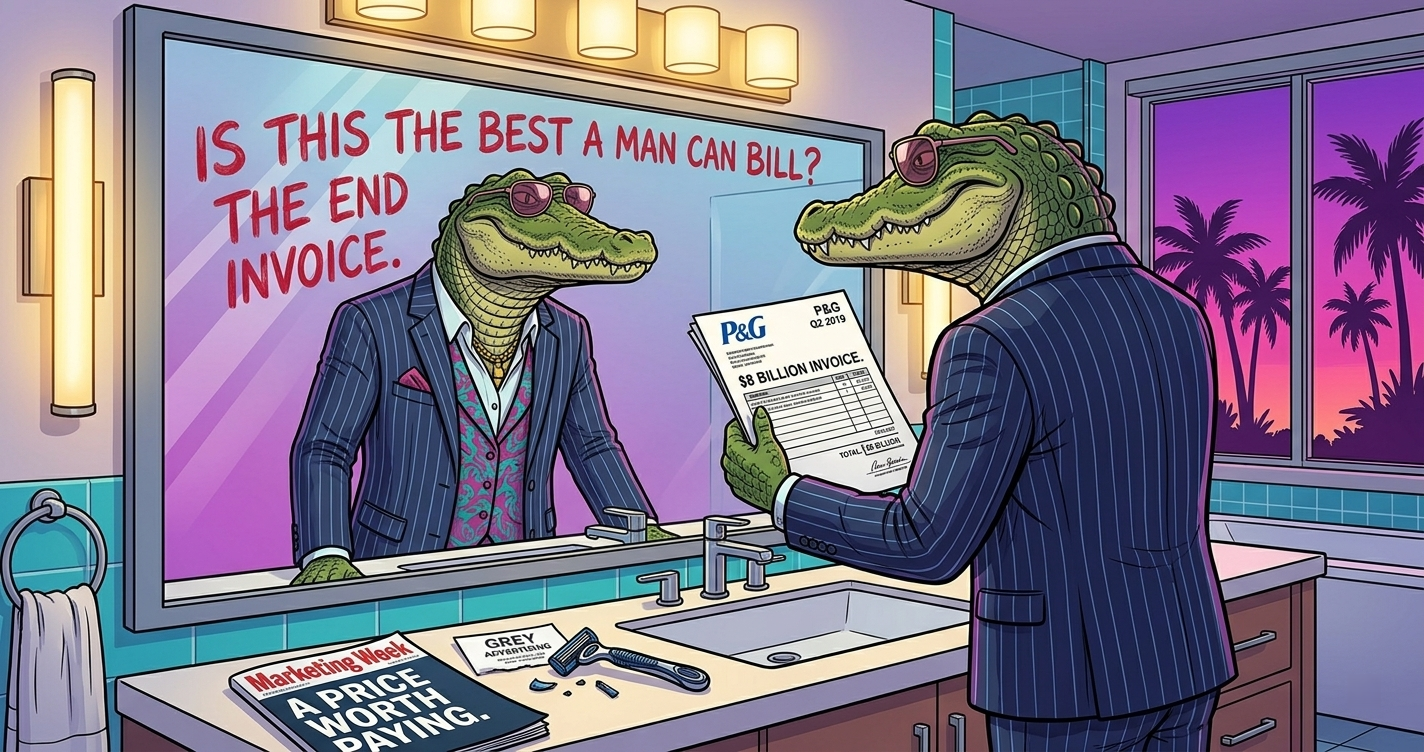
ACT I — THE PITCH
January 2019 · "Is this the best a man can get?"
Gillette has a tagline. It has had this tagline since 1989. The tagline is “The Best A Man Can Get.” For thirty years, it appeared on razor packaging, television commercials, and stadium signage. It was voiced over shots of tuxedoed athletes, kissing brides, hugging fathers. It was not subtle. It was not clever. It was successful. Between 1989 and 2016, Gillette held between 55% and 71% of the American razor market — a level of dominance so complete that antitrust regulators occasionally asked questions. [IESE Business School]
In January 2019, Gillette decided that the tagline was politically inconvenient. So they changed it. Grammatically, the change was one word. “The Best A Man Can Get” became “The Best Men Can Be.” Financially, the change was $10 billion. Somewhere in the P&G archives, there is a Microsoft Word document showing the meeting where a junior copywriter suggested the edit. Sonny would pay $50 for that document. Sonny would also frame it. The document represents the single most expensive word substitution in the history of consumer goods marketing — thirty years of brand equity replaced with a preposition — and nobody in the room asked whether the customer would notice.
The cultural moment was specific. #MeToo had toppled Harvey Weinstein in October 2017. Terry Crews had testified before the Senate Judiciary Committee in June 2018, describing his own sexual assault and coining the phrase “cult of toxic masculinity.” Christine Blasey Ford had testified against Brett Kavanaugh in September 2018. Every brand in America was trying to figure out how to monetize the reckoning. Nike had just done it with Colin Kaepernick — losing 3% of its stock price for a week and gaining $6 billion in market capitalization over the following six months.
Gillette wanted its Kaepernick moment. Gillette also sold razors to men.
Six days before the ad launched, on January 7, 2019, the American Psychological Association released 36 pages of professional guidelines on how psychologists should treat men. It was the first document of its kind in the APA’s 127-year history. The document stated that “traditional masculinity” was psychologically damaging and “intrinsically linked to homophobia, misogyny, and aggression.” Every major newspaper covered the release. The APA’s press release was posted at 9:00 AM Eastern. By noon, the phrase “traditional masculinity” was trending on Twitter.
Somebody at Procter & Gamble looked at this convergence — the APA report, the Kaepernick precedent, the ongoing #MeToo reckoning, the January news cycle — and thought: this is our moment. That “somebody” was almost certainly not one person. Corporate marketing decisions of this magnitude require approval from at least a dozen executives, a legal review, a media buy, and coordinated launches across six platforms. The decision was made months in advance. The launch date was chosen for maximum impact. Nobody thought it was subtle. That was the point.
January 11, 2019: The Warning Shot
At 5:45 PM Eastern on Friday, January 11, Gillette’s official Twitter account posted:
"Boys will be boys"? Isn't it time we stopped excusing bad behavior? Re-think and take action by joining us at TheBestMenCanBe.org. #TheBestMenCanBe
The tweet received 3,982 likes over the weekend. More importantly, it linked to a purpose-built website — TheBestMenCanBe.org — featuring a countdown timer to the ad’s Sunday release. This is unusual behavior for a company whose entire product line consists of small blades attached to plastic handles. When a razor company launches a countdown-timer website for a two-minute video, the razor company is not selling razors. The razor company is selling something else. What that something else is depends on who you ask. [PinkNews]
January 13, 2019: The Release
At approximately 10 AM Eastern on Sunday, January 13, 2019, Gillette released a 1-minute-49-second video on YouTube and Twitter. The video was titled “We Believe: The Best Men Can Be.” It was created by Grey New York, P&G’s global grooming advertising agency, and directed by Kim Gehrig of production company Somesuch — an Australian-born, London-based commercial director whose previous work included Sport England’s award-winning “This Girl Can” campaign and a Libresse ad for Bodyform featuring animated singing female genitalia. [SHOOT Online]
The video contained zero razors.
It also contained zero mentions of shaving.
It did contain, in order: bullying, catcalling, a sitcom joke about grabbing a woman, a male executive mansplaining to a female colleague, a father saying “boys will be boys,” news footage of #MeToo, and footage of Terry Crews testifying before the Senate saying “men need to hold other men accountable.” Halfway through, a narrator intoned: “Something happened. And there will be no going back.” The final third of the ad featured montage footage of men intervening in bullying, breaking up fights, and modeling positive behavior for children.
The ad was, in the technical language of purpose-driven marketing, “value-based storytelling.”
The ad was, in the technical language of Gillette’s core customer base of 30-to-60-year-old American men, “an attack on men.”
The Terry Crews Paradox
The clip Gillette used — Terry Crews at the Senate Judiciary Committee, saying “men need to hold other men accountable” — was not the entire testimony. The full testimony, delivered under oath on June 26, 2018, was a survivor account. Crews described being groped by a Hollywood talent agent at an industry party in 2016. He described reporting the incident. He described being told, by his own representation, to stay quiet or lose work. He coined the phrase “cult of toxic masculinity” in that testimony — and defined it narrowly, surgically, as the specific pressure inside male professional networks to protect predators. That was his definition. That is a definition.
Gillette used the clip without alteration. Terry Crews retweeted the ad approvingly the same day. Terry Crews is a Black man. Terry Crews played in the NFL. Terry Crews weighs approximately 240 pounds. Terry Crews’ testimony was surgical. Gillette’s ad was aerial bombardment. Terry Crews was not the target of the backlash. The target of the backlash was every man Terry Crews had explicitly said was not the problem — the ordinary customers who had never groped anyone, never protected a predator, never done anything that would have interested the Senate Judiciary Committee. Gillette borrowed Crews’ credibility to make a point Crews himself had not made. Crews was a witness. Gillette treated him like a prosecutor. The distinction cost $10 billion.
Alongside the release, Gillette announced a $1 million per year, three-year charitable pledge — $3 million total — to non-profit organizations “designed to help men achieve their personal ‘best.’” The first partner: The Boys & Girls Clubs of America. Damon Jones, P&G’s Vice President of Global Communications, told Good Morning America: “Gillette is using our platform to advance a more modern, positive vision of what it means for men to be at their best.” [ABC News / GMA]
Three million dollars for charity. Against, eventually, $10 billion in writedowns. The eventual ratio would be $3,333 in corporate losses for every $1 in charitable giving. Every dollar that reached the Boys & Girls Clubs cost the P&G shareholders more than a family sedan.
Pankaj Bhalla, Gillette’s North America brand director, told NBC News that the campaign was not opportunistic. “I think the primary driver of why we wanted to have the conversation was because when we were searching for the best definition — the 2019 definition — of the best a man can get, it became critically clear that many men are incredibly good but they can do so much to be better.” [NBC News]
Read that sentence carefully. “Many men are incredibly good but they can do so much to be better.” This is the corporate translation of “you’re not good enough yet.” It is the language of the manager who tells you at year-end review that you exceeded expectations but there is still room for growth. It is not a compliment. It is a demand disguised as an observation. It is, above all, unsolicited. The customer did not ask Gillette for a definition of the 2019 man. The customer asked Gillette for a razor.
Nobody had a warning that the razor company had opinions. Nobody had asked for the homework.
In their defense: the moment was real
Let’s be fair to Gillette for a paragraph. #MeToo was not fake. The APA guidelines were not fake. The cultural reckoning was not a hallucination invented by the P&G marketing department at 3 AM. Men were, in fact, behaving badly at scale, and the fact that most men were not personally behaving badly did not change the fact that the culture needed correcting. Nike had just proven that a corporation could pick a side on a hot cultural issue and profit from it. The Cannes Lions had spent the previous three years handing awards to “purpose-driven” work. Every consumer goods brand in America was, at that exact moment, trying to figure out how to take a stand without losing money. Gillette tried. Gillette also lost $10 billion. Both things are true. The moment was real. The math was wrong. The math is always the problem in these stories. The math is what Sonny is here to check.
ACT II — THE BACKLASH
January – July 2019 · "It was a price worth paying to be relevant."
January 14, 2019, 3:57 PM: Welcome to the Club
Twenty-six hours after Gillette released “We Believe,” a competitor responded. The competitor was Dollar Shave Club, a subscription razor service that had been founded in 2011, acquired by Unilever for $1 billion in 2016, and had spent the intervening three years quietly stealing Gillette’s market share by mailing cheap blades to customers who did not want to shop at CVS.
Dollar Shave Club’s response was a single tweet, posted at 3:57 PM Eastern:
"Welcome to the Club."
That was the entire tweet. Three words. No image. No hashtag. No @mention of Gillette. No context. No commentary. Just an implication — that Gillette had, by lecturing its own customers, joined a category to which Dollar Shave Club had always belonged: the razor category. Or, more precisely: the category of razor companies whose customers were leaving Gillette. [Latana]
The tweet accumulated 15,000 likes and 3,000 retweets over the following days. Those numbers are unremarkable by 2019 Twitter standards. What was remarkable was the replies. The replies were tens of thousands of men publicly announcing that they had just switched their razor subscription from Gillette to Dollar Shave Club. “The new Gillette ad sent me here. You got yourself a new customer,” one wrote. “Hi @DollarShaveClub. Would you like to have another client?” asked another.
A user asked: “What are the rules to your club?”
Dollar Shave Club replied twenty hours later:
"Take care of yourself. Respect others. Buy our stuff."
Nine words. Three sentences. It said everything Gillette’s 109-second film tried to say — but it said it in the language of a razor customer, not the language of an HR trainer. It respected the customer. It didn’t lecture. It had a punchline. And, crucially, it sold razors.
The internal irony was rich and stayed private for years. Dollar Shave Club was owned by Unilever — a British-Dutch consumer goods conglomerate that had itself been running “modern masculinity” advertising campaigns for its Schick and Harry’s razor brands throughout 2018. The same corporate playbook. Different execution. Opposite outcome. Unilever’s brands attacked “toxic masculinity” quietly, indirectly, using specific vignettes about specific men. Gillette attacked it broadly, directly, using every man on Earth as a suspect. Unilever won this round because Unilever had learned to whisper. Gillette had never learned to do anything but shout.
The Piers Morgan Campaign
Piers Morgan — British television host, former Daily Mirror editor, professional outrage merchant — declared war on Gillette within 24 hours. His tweets called the ad “a direct consequence of radical feminists” who were “driving a war against masculinity.” He wrote columns in the Daily Mail titled things like “The Best A Pathetic Virtue-Signalling Ad Can Get.” He appeared on Good Morning Britain and read the ad’s script aloud in a mock-solemn voice for six minutes. By January 16, “Piers Morgan Gillette” was the second-most-searched Google term in the United Kingdom. [The Guardian]
Then something happened that should have been a warning to Gillette’s marketing department about the reliability of its most enthusiastic critic.
Five days before the Gillette ad launched, on January 9, 2019, Piers Morgan appeared on the same Good Morning Britain program to complain about #Januhairy — a British movement encouraging women not to shave their body hair during January. On live television, Morgan looked at a photograph of Madonna’s unshaven armpits and called them “lazy and revolting.” He said, “Why be so lazy? They just can’t be bothered to shave?” The clip was clipped, tweeted, and viewed millions of times. [Yahoo News UK]
So: the man who spent the week of January 9 publicly shaming women for having body hair spent the week of January 14 publicly defending Gillette’s traditional celebration of masculinity. A man defending razors. Shaming women about hair. In a single week. On national television.
Piers Morgan’s editorial position, translated: razors are for men, hair is for razors, and if you don’t use one you’re revolting. This is the man Gillette’s PR crisis strategy inherited as its most vocal defender. Not through Gillette’s choice. Just through the natural gravitational pull of the news cycle. When the loudest voice defending your brand is the voice that just called Madonna’s armpits “lazy,” the brand does not have a defender. The brand has a hostage situation.
If Gillette’s marketing department had spent ten minutes searching Google for their most prominent defender’s recent statements, they would have found that Piers Morgan’s core position on razors was: women should use them or shut up. That is not an ally. That is a walking liability who happens to be pointing in your direction this week.
The screenshot of Piers Morgan’s outrage should be framed at Gillette headquarters as a warning about who your allies actually are.
The YouTube Numbers
By January 17, 2019 — four days after release — the video had 2.8 million views and 250,000 dislikes, against 60,000 likes. A dislike ratio of roughly 4:1. By late January — two weeks in — it had 14 million views and 441,000 dislikes against 139,000 likes. By March — two months in — dislikes crossed 1 million. By December 2019 — eleven months in — dislikes hit 1.56 million, cementing “We Believe” as one of the most disliked non-music videos in YouTube history at that time. [Medium/Pranav Guru]
But the dislikes are not the interesting number. The interesting number is the comment deletions.
According to an independent analysis by SIE Magazine using YouTube’s public API and Archive.fo screenshots, Gillette’s account deleted approximately 34% of the video’s 500,000+ comments over the first six weeks. That deletion rate is a potential YouTube record for a single video’s proportional comment removal. The absolute record still belongs to YouTube’s own Rewind 2018 video — which is not a fair comparison, because YouTube can delete comments on its own videos without a public relations problem. Gillette is a shaving company. Gillette does not have a mandate to moderate speech on YouTube. Gillette deleted them anyway. [SIE Magazine]
The comments Gillette deleted weren’t personal attacks. They were customers. They were 30-year-old men in Ohio typing “I’ve used your razors since I was 15 and I’m switching to Harry’s tomorrow.” They were 45-year-old fathers in Texas typing “You just called my son a bully because he’s a boy.” They were paying customers explaining, in real time, why they were canceling their subscriptions. Gillette’s response to this feedback was to delete it, presumably so that the remaining feedback would look more supportive.
Gillette then disabled comments on the video entirely. Then Gillette hid the dislike count. Then, in November 2021 — nearly three years later — YouTube globally hid all dislike counts across the entire platform. YouTube’s official explanation cited “creator wellbeing” and reducing dislike-attack campaigns. The unofficial explanation, cited by observers and reporters at the time, was that YouTube had been under sustained pressure from advertisers whose branded content was accumulating public rejection metrics that made the branded content difficult to place. Gillette’s ad did not just lose the argument. Gillette’s ad helped rewrite YouTube’s platform-wide dislike policy.
The #PinkTax Backfire
Three days after “We Believe” launched, Twitter users started sharing side-by-side photos of Gillette’s men’s and women’s razors. Same physical product. Same five-blade cartridge design. Same plastic handle. Different color. Different price. A five-pack of women’s razor cartridges typically retailed for $2 more than the identical five-pack of men’s cartridges. This was not a Gillette-specific practice — the “pink tax” phenomenon extended across multiple product categories, from dry cleaning to children’s clothing — but Gillette had, three days earlier, positioned itself as the razor company that lectured men about how they treated women. [AOL / #PinkTax coverage]
The hashtag #PinkTax trended alongside #BoycottGillette. Multiple journalists filed stories. Consumer advocacy groups issued statements. Female influencers posted receipts. The message was clear and cheap: Gillette wants to lecture men about how they treat women — while charging women more for the same physical object.
Gillette said nothing. The pricing did not change. The company’s PR team made a strategic calculation that responding to the pink tax accusation would extend the news cycle. So Gillette simply did not respond. This is what marketing consultants call “letting the story die.” What actually happened is that the story didn’t die. It just got absorbed into a larger story — the story of a company that talked about equality while practicing inequality — and that larger story got told, later, in every marketing school case study about the campaign.
The Egard Response
On January 22, 2019, a small Illinois watch company called Egard Watches released a response ad titled “What Is A Man.” It ran 2 minutes and 41 seconds. Egard Watches was a niche brand — its 2018 annual revenue was under $10 million, its team was seven people, and its Instagram following was 22,000. Egard Watches was not a razor company. Egard Watches sold watches. But Egard Watches understood the marketing opportunity Gillette had just created.
The ad opened with a single statistic on a black screen: “Men make up 79% of suicide victims.” It then cut to news footage of male firefighters running into burning buildings, male soldiers embracing daughters at homecomings, male teachers coaching Little League, single fathers at PTA meetings. It ended with a quiet voiceover from Egard’s founder, Ilan Srulovicz: “Everyday, men in the world sacrifice. And every day, we are told they are the problem.”
Within 24 hours, Egard’s response had 1,566,765 YouTube views — a like-to-dislike ratio of 75 to 1. That is not a typo. Seventy-five likes for every dislike. In an era when most viral content struggles to break 10:1, Egard achieved 75:1 with a two-minute-and-forty-one-second video shot for approximately $40,000. [BU Today]
Srulovicz gave one interview about the campaign, to the BBC. “We’re not attacking Gillette,” he said. “We’re just saying men aren’t a problem to be solved.” That was the entire competitive strategy. Say the thing Gillette’s customers wished Gillette had said. Egard sold out of their spring inventory in six weeks. Their 2019 revenue tripled. Their Instagram following passed 250,000 by summer. A watch company had turned a razor company’s campaign into a marketing case study — for the watch company.
The Buzz Score Collapse
Data from YouGov’s BrandIndex tracked Gillette’s “Buzz Score” — a proprietary measure of consumer perception ranging from -100 to +100. The score aggregates thousands of daily consumer interviews asking whether a respondent has recently heard anything positive or negative about a brand.
A nine-point collapse in seven days. Gillette had spent 30 years and hundreds of millions of dollars building brand equity. They spent that equity in a single weekend. The Buzz Score would not recover to pre-January-2019 levels for the next four years.
July 30, 2019: The $8 Billion Confession
Six months and seventeen days after “We Believe” launched, Procter & Gamble held their Q4 FY2019 earnings call. The company announced an $8 billion non-cash impairment charge on the Gillette business. This was formally described in the SEC filing as being driven by “reductions in the estimated fair value of the Gillette indefinite-lived intangible assets.” Translated from accountant to English: Gillette was worth $8 billion less than we said it was. [CNBC]
CFO Jon Moeller gave the market the official explanation:
"Currency devaluations and volatility, particularly emerging markets, coupled with declining shave frequency and demand for wet-shaving products globally."
Two things caused the $8 billion writedown, according to P&G’s CFO: (1) foreign currency exchange rates, and (2) men shaving less because they were growing beards. He did not mention the ad. At no point during the earnings call did any executive at P&G mention the ad. The word “backlash” was not spoken. The word “boycott” was not spoken. The phrase “toxic masculinity” was not spoken. The reason was, officially, beards.
This is a remarkable choice. When you write down $8 billion in acquired intangible assets on a brand that just released the most-discussed advertising controversy of the calendar year, and you attribute the writedown to currency exchange rates and facial hair, you are asking the analyst community to believe two things: first, that currency fluctuations of that magnitude were not present at the time of your prior quarterly impairment testing, and second, that men had suddenly started growing beards in the specific quarter following your ad campaign. Neither claim is remotely plausible. But neither claim is disprovable in a way that generates a public relations problem. And so both claims were made. And the SEC did not question them. Because “management’s judgment about the estimated fair value of intangible assets” is the kind of accounting decision that only becomes fraud if somebody testifies that management knew it was wrong. Nobody at P&G was going to testify that management knew it was wrong.
Gary Coombe: "A Price Worth Paying"
In July 2019 — the same month as the $8 billion writedown — Gary Coombe, then CEO of P&G’s Global Grooming Business (which included Gillette), gave a candid interview to Marketing Week. His quote, delivered as if it were self-evidently correct:
"If we didn't attract some blowback, given the way society is right now, we wouldn't be relevant. It was a price worth paying to be relevant, to be talked about, to be in the conversation."
Read that sentence again.
Coombe was not saying “I regret the ad.” He was not saying “we underestimated the reaction.” He was saying: alienating our existing customer base was the plan. The alienation was the point. The $8 billion writedown was the strategy working correctly. Every dollar of impaired goodwill was a data point proving that Gillette had successfully “entered the conversation.” The customers who left were the price. The relevance was the prize.
Coombe, at this point in his career, had been at P&G for 33 years. He had four decades of consumer goods experience. He had personally grown Febreze into a billion-dollar brand. He had run P&G’s European operations. He was not a marketing rookie. He was one of the most experienced brand managers in the global consumer goods industry, and he looked at $8 billion in impaired assets, at 1.56 million YouTube dislikes, at a nine-point YouGov buzz score collapse, and at a competitor tweet that read “Welcome to the Club” — and he told the marketing press: this was worth it.
Gary Coombe was promoted the following year. He continued running Gillette for five more years. He was subsequently named P&G’s Executive Sponsor of Corporate Wellbeing — leading, per his official P&G bio, “Company-wide efforts to create an environment where all P&G employees are empowered to be at their best every day.” The man who wrote a campaign titled “The Best A Man Can Be” was made responsible for helping his colleagues be their best. In June 2026, Exchange4media reported that Coombe had announced his retirement effective September 2026 after 40 years at the company. His farewell LinkedIn post referenced “passion projects and board roles.” Nobody who read the post mentioned $8 billion. [Exchange4media]
In their defense: "a price worth paying" is at least honest
Most executives, after a $8 billion writedown, would blame currencies. Coombe blamed currencies too — that’s what CFOs are for — but in his own interview, on his own terms, in his own words, he said the quiet part out loud. He told Marketing Week the alienation was intentional. He told Marketing Week the customers who left were the price of relevance. He told Marketing Week, essentially: we knew what we were doing and we’d do it again.
This is, in a certain light, admirable candor. Most fumbles get buried in the language of “strategic repositioning” and “brand recalibration.” Coombe skipped the euphemisms. He named the trade. He said: we traded customers for cultural relevance, and we consider the trade a win. The problem is not that Coombe was lying about the strategy. The problem is that the strategy, stated clearly and out loud, was: lose customers on purpose, count it as marketing. That is not a strategy. That is a spending plan disguised as a philosophy. Coombe was, for one interview in July 2019, the most honest CEO in the consumer goods industry. The honesty cost his shareholders $10 billion. Sonny appreciates the candor. Sonny still invoices.
The Marketing Week interview, seven years later, remains on the internet. It is quoted in three separate marketing textbooks. It is cited in the IESE Business School case study. It is the first Google result for “Gary Coombe Gillette.” The archives always remember. The archives don’t get promoted. The archives don’t retire. The archives just sit there, on Marketing Week’s own CMS, waiting for the next MBA student to write a case study.
ACT III — THE QUIET RETREAT
2020 – 2026 · "We're excited to announce the launch of King C. Gillette — for men with facial hair."
May 26, 2020: The Beard Oil
Sixteen months after the $8 billion writedown, and ten months after CFO Jon Moeller publicly blamed the writedown on declining shave frequency, Gillette launched a new product line. [PRNewswire]
The line was called King C. Gillette. It was named after King Camp Gillette, the company’s founder from 1901. The launch press release, dated May 26, 2020, described the line as:
"A new brand offering the complete range of tools and products any man needs to help him perfect his facial hair style and grooming regimen at home."
The line included: beard wash, beard balm, beard oil, and a double-edge safety razor of the same design King Camp Gillette had invented in 1901. The signature scent, developed in partnership with an international fragrance house, contained: top notes of cardamom and ginger, heart notes of lavender and bourbon oil, and base notes of patchouli and sandalwood.
A brief word about the founder. King Camp Gillette was born in Wisconsin in 1855. He invented the disposable safety razor in 1901. He built his entire fortune, and the entire premise of the American shaving industry, on a single business insight: shave more, buy more razors. The whole model — the low-margin handle, the high-margin cartridge, the subscription-adjacent economics of the modern grooming aisle — was King Camp Gillette’s original math. In 2020, the company he founded launched a beard oil bearing his name. Beard oil is what you use when you are not shaving. If King Camp Gillette had known that his life’s work would end with his surname on a $12 bottle of patchouli-scented beard balm, he might have chosen a different career. Or a different name. Or a different heir. He is buried in Los Angeles. He is unavailable for comment.
Let’s review the timeline carefully.
The signature scent narrative — per the official press release — was designed to “evoke the brand’s narrative of history and heritage combined with modern masculinity.” Read that phrase: history and heritage combined with modern masculinity. Sixteen months after releasing an ad that told men their masculinity was toxic, Gillette launched a product line whose entire brand positioning was: history, heritage, and modern masculinity.
The public statement came from Gary Coombe personally:
"We're excited to announce the launch of the King C. Gillette range — the first complete lineup of products and tools designed for men with facial hair."
The man who told Marketing Week that alienating customers was “a price worth paying” was now excitedly launching a $29.99 beard oil for the exact customers he had alienated. If you were one of the 1.56 million people who disliked “We Believe” in 2019, and you were still growing a beard in 2020, Gillette wanted to sell you a $12 bottle of beard balm scented with patchouli and sandalwood. The customer was still the customer. The customer had just been called toxic sixteen months earlier. That was, apparently, water under the bridge. Water under the bridge with notes of cardamom.
In their defense: cardamom is objectively delicious
Sonny will not deny the fragrance. Cardamom is a strong choice. Lavender is a safe choice. Bourbon oil is an aspirational choice. Patchouli and sandalwood are the base notes of every men’s grooming product launched between 2018 and 2024, and there is a reason: they smell good, they layer well, and they suggest complexity without demanding it. Gillette’s fragrance house did not do a bad job. The beard oil, as beard oil goes, is fine. The scent, as men’s grooming scents go, is above average. The product, as a product, was engineered by people who know how to engineer products. This is what makes the launch surreal. The company did everything right on the product side. Great scent. Solid packaging. Reasonable pricing. Established distribution. Everything a beard oil launch should have, this beard oil launch had. The only thing this beard oil launch also had was the CEO who, sixteen months earlier, had made a two-minute advertisement telling the target customer his masculinity was toxic. Everything about King C. Gillette works — except the timing, the source, and the fifty-eight thousand YouTube comments the parent company had recently deleted.
June 2021: The Burj Khalifa
In June 2021, Gillette expanded the King C. Gillette line into the GCC region — Saudi Arabia, UAE, Qatar, Bahrain, Kuwait, Oman — via a promotional broadcast on the exterior of the Burj Khalifa, the world’s tallest building. The launch imagery was projected onto the 828-meter tower over multiple evenings and photographed for international press coverage. [PRNewswire GCC launch]
The regional Commercial Leader for P&G Middle East and Africa, Tarek Abdelaziz, gave the launch quote:
"Facial hair has moved beyond niche to a mainstream aspiration of masculinity, with 66% of Arabic men and 55% of Asian men growing and grooming their facial hair."
Sixty-six percent of Arabic men grow beards. Often for religious reasons. Often for cultural reasons. Frequently for both. This is not a subtle demographic pattern. It has been the case for approximately 1,400 years. And in January 2019, Gillette had made an advertisement framing “traditional masculinity” as a global problem requiring corporate intervention. And in June 2021, Gillette rented the largest building on Earth to sell beard products to a market where the majority of men grew beards as an expression of cultural and religious identity that Gillette’s 2019 ad had implicitly criticized as backward.
The retreat was total. Nobody at P&G ever said the words “we were wrong.” They just rented the Burj Khalifa, projected King C. Gillette imagery onto the world’s tallest building, and started selling cardamom-scented beard oil to the men their 2019 campaign had implicitly told to shave. The cardamom, presumably, was still delicious. The Burj Khalifa, presumably, was still tall. The apology, presumably, was in the mail.
December 5, 2023: The Second Writedown
Four and a half years after the first writedown, Procter & Gamble reported another one. On December 5, 2023, at a Morgan Stanley investor conference, P&G announced a $1.3 billion non-cash impairment charge on the Gillette business, to be recorded in Q4 calendar 2023 (fiscal Q2 2024). The company also announced restructuring charges of $1 billion to $1.5 billion after tax over fiscal years 2024 and 2025 — related primarily to closing operations in Argentina and Nigeria and converting Nigerian operations to import-only. Total additional writedown: $2.3 to $2.8 billion. [CNBC]
The CFO was no longer Jon Moeller — Moeller had been promoted to CEO of the entire company. The CFO was now his successor, Andre Schulten. Schulten gave the market a familiar explanation:
"Stronger U.S. dollar and slowing volume growth due to the hybrid post-pandemic work culture."
Currencies. Beards. And now, working from home.
Three consecutive P&G CFOs had now explained multi-billion-dollar Gillette writedowns using every possible economic variable except the one that was actually true. The dollar was strong. Men were growing beards. Employees were working remotely and shaving less. The stated reasons kept changing. The writedowns kept coming.
The Agency That Kept the Account
A word about Grey New York, the WPP-owned advertising agency that actually created “We Believe.”
Grey was not fired. Grey was not replaced. Grey was not put on notice. Grey New York produced a 109-second video that eventually cost their client $10 billion in impaired assets, and Grey New York kept the P&G account. As of 2026, Grey still handles multiple P&G brands, including Gillette’s global creative. This is what agency loyalty looks like. This is also what agency options look like. P&G could not fire Grey without admitting the ad was the problem — and admitting the ad was the problem would have made the $8 billion writedown much harder to attribute to currencies. So Grey stayed. So the CFO’s explanation stayed. So the money went out the door on schedule. Everyone in the agency pitch room got to keep their job, because firing anyone would have required naming the actual cause of the impairment, and the actual cause of the impairment was in the meeting where they all approved the ad.
This is what corporate accountability looks like at the very top. It looks like nobody being fired for anything, because firing anyone would require paperwork identifying the person being fired for the specific thing they did, and the specific thing they did is the same specific thing everyone else in the room did, and everyone in the room signs the paperwork.
The Executives Who Went Quiet
Two names you probably don’t recognize: Damon Jones and Pankaj Bhalla.
In January 2019, Damon Jones was P&G’s Vice President of Global Communications. He was on Good Morning America defending the ad. He told viewers Gillette was “advancing a more modern, positive vision.” Pankaj Bhalla was Gillette’s North America brand director. He was on NBC News defending the ad. He told viewers Gillette had spent time “searching for the best definition — the 2019 definition — of the best a man can get.”
In July 2019, when the $8 billion writedown was announced, Damon Jones did not appear on Good Morning America. Pankaj Bhalla did not appear on NBC News. Neither executive gave a single interview connecting the ad to the writedown. Neither executive addressed the customers who had defected to Dollar Shave Club. Neither executive acknowledged that the campaign they had defended six months earlier had, in the intervening period, cost their employer more money than most Fortune 500 companies earn in a decade.
This is not a criticism. This is job protection. When the ad launches, the Vice President of Global Communications speaks. When the ad costs $8 billion, the Vice President of Global Communications gets very, very quiet. This is the corporate media defense mechanism working exactly as designed. The people who defend the campaign in month one are not the people who explain the writedown in month seven. The corporate pyramid absorbs the impact by making sure the person who would take the heat is never actually the person in the room when the heat arrives.
Damon Jones is still at P&G as of 2026. Pankaj Bhalla left Gillette in 2020 for a marketing VP role at another consumer goods company. Neither’s LinkedIn profile mentions “We Believe.” Neither résumé references the $8 billion. The archives, again, remember. The résumés, again, do not.
The Gehrig Comeback
Kim Gehrig, the director of “We Believe,” did not have a comfortable 2019. She received death threats. Her home address was published on Reddit. She stopped giving press interviews for eighteen months. Her work was labeled — by people who had never watched it — as an attack on men.
Then she went back to work.
In 2020, she directed Nike’s “You Can’t Stop Us” — a two-minute film using split-screen composited footage of Naomi Osaka, LeBron James, Serena Williams, and dozens of amateur athletes. The ad accumulated 44 million YouTube views in its first weekend and was included in nearly every year-end “Best Ads of 2020” list.
In 2021, she directed Nike’s “Dream Crazier” — a companion piece to the Kaepernick campaign focused on female athletes. The ad won a Cannes Silver Lion.
In 2022, she directed Apple’s “The Greatest” — a two-minute film about the company’s accessibility features. It won the Emmy Award for Outstanding Commercial.
In 2023, she became only the second woman in history to win the Directors Guild of America Award for Outstanding Directorial Achievement in Commercials — the top honor in the American commercial directing profession, previously won only once by a woman, in 2019, by fellow director Melina Matsoukas. [Variety]
In 2025, industry press described Kim Gehrig as “the most sought-after commercial director in the world.”
The people who spent 2019 trying to end Kim Gehrig’s career lost. She won Cannes. She won an Emmy. She won a DGA Award. The people who threatened her online in 2019 went back to their day jobs — mostly returning to Twitter accounts with 400 followers, unfinished screenplays, and diminishing outrage-per-hour metrics. Kim Gehrig went to work at Apple. The distribution of consequences here is worth naming: the woman who directed the ad has an Emmy. The men who wanted her fired have a Twitter account. The market has spoken.
The Market Share Verdict
Gillette’s U.S. razor market share trajectory:
Two observations are structurally important. [IESE / Case Centre]
First: Gillette was already losing market share before “We Believe.” The 71% to 56% decline from 2010 to 2016 happened without any political marketing. It happened because Dollar Shave Club, Harry’s, and the private-label brands sold at Target and Walmart offered comparable products at 40% lower prices. Consumers stopped paying $18 for four Gillette cartridges when they could pay $7 for four Harry’s cartridges shipped directly to their door. The problem was economic before it was cultural.
Second: “We Believe” did not cause Gillette’s decline. But “We Believe” accelerated a decline that was already in progress and, more importantly, locked in a customer perception — “the brand that lectures you” — that made recovery structurally difficult. Once a brand is remembered as the one that told you your masculinity was toxic, no beard oil launch, no Burj Khalifa broadcast, no $29.99 signature scent will fully reverse the perception. The brand has to spend the next decade being remembered as something else. And Gillette hasn’t done that. Gillette has spent the last seven years being remembered as the brand that fumbled.
The Nike Comparison
Four months before “We Believe,” in September 2018, Nike launched its Colin Kaepernick campaign titled “Believe in Something. Even If It Means Sacrificing Everything.” The initial reaction was identical to what Gillette would experience four months later. Boycott hashtags. Viral videos of angry customers burning Nike shoes. Piers Morgan columns. Sean Hannity segments. Presidential tweets from Donald Trump attacking the campaign directly. Nike stock initially dropped 3%.
Six months later, Nike stock was up 15%. Nike had gained approximately $6 billion in market capitalization.
Gillette, four months after “We Believe,” wrote off $8 billion.
The playbook was identical. The outcome was opposite by $14 billion. This is not a rounding error. This is not a coincidence of market timing. This is a structural difference in how the two campaigns were constructed — and understanding the difference is the single most valuable lesson in this entire story.
What did Nike do differently?
Nike’s ad featured one athlete taking one specific action against one specific institutional problem (police brutality against Black Americans, NFL responses to peaceful protest). The customer, watching the ad, did not feel accused. The customer either agreed with Kaepernick’s protest, or they didn’t — but the customer was not the target. The target was the NFL. The target was the American criminal justice system. The customer was invited to be a witness, not a defendant.
Gillette’s ad featured every man on Earth as a suspect in a systemic problem (toxic masculinity). The customer, watching the ad, was implicitly one of the men needing to hold “other men” accountable. The customer was, whether he agreed with the message or not, part of the target audience for correction.
Nike said: look at this brave person doing this brave thing.
Gillette said: look at yourself. Be better.
One is inspiring. The other is homework. The $14 billion difference between +$6 billion and −$8 billion is the difference between “look at that hero” and “look at yourself.” Nike sold the customer a role. Gillette sold the customer a grade. Nobody buys $18 razor cartridges to receive a grade.
Gillette Stadium
Meanwhile, in Foxborough, Massachusetts, Gillette Stadium — the home venue of the NFL’s New England Patriots and MLS’s New England Revolution — is still called Gillette Stadium. P&G’s naming rights contract runs through the 2031 NFL season. The original 15-year contract signed in August 2002 was worth $105 million, or $7 million per year. The 2010 extension terms were not publicly disclosed but industry estimates place the current annual value at approximately $8 million. [New England Patriots]
Gillette is paying $8 million per year to put its name on a stadium hosting a sport whose entire cultural apparatus — physical dominance, controlled violence, aggression as competitive virtue — represents everything the 2019 ad had criticized. Every Sunday in the fall, tens of thousands of exactly the demographic Gillette’s “We Believe” campaign had insulted gather in Foxborough to watch NFL football under signage that reads GILLETTE in fifty-foot letters.
Every Sunday, the NFL demographic buys beer. Every Sunday, the NFL demographic buys hot dogs. Every Sunday, the NFL demographic buys jerseys. And every Sunday, the NFL demographic — the specific demographic Gillette’s “We Believe” campaign had spent 109 seconds criticizing — walks past GILLETTE STADIUM signage that P&G is paying $8 million a year to keep in place through 2031.
Nobody at P&G ever brought up the contradiction publicly. Nobody at P&G ever proposed exiting the naming rights deal early. The $8 million per year continues to flow. The 2019 ad continues to be studied in marketing textbooks. And the NFL continues, to this day, to be the primary cultural transmission mechanism for the exact “traditional masculinity” that Gillette’s 2019 ad framed as a societal problem. The company that criticized football culture is paying $8 million a year to sponsor a football stadium. If irony had a rent, Gillette would owe back payments through 2031.
The Charity Bill
The $1 million-per-year, three-year charitable pledge Gillette announced alongside “We Believe” — the pledge to help men achieve their personal best via The Boys & Girls Clubs of America and other partners — was, per available public reporting, delivered as promised.
This is not a criticism of the Boys & Girls Clubs of America, whose youth programs have been providing after-school care and mentorship since 1860 and are one of the most respected charities in the country. This is a criticism of a corporate communications strategy that spent one hundred times more losing brand equity than it spent on the charitable objectives the brand equity loss was supposedly designed to advance. If Gillette had simply written a $10 billion check to the Boys & Girls Clubs and released no advertising, the Boys & Girls Clubs would have received 3,333 times more funding, Gillette would have received the same amount of press coverage, and Gary Coombe would have never had to explain to Marketing Week what “a price worth paying” meant. The efficiency gain would have been catastrophic. In every direction, for everyone.
A brief note on scale. The Boys & Girls Clubs of America serve approximately 4 million young people through 5,000 club locations. Their annual operating budget is approximately $1.9 billion. Gillette’s three-year, $3 million pledge represented approximately 0.05% of the Boys & Girls Clubs’ operating expenses over that same period. Rounded to the nearest half of a tenth of a percent. If you missed it, don’t feel bad — most people miss 0.05%. The Boys & Girls Clubs certainly appreciated the money. They also would have appreciated more of it. Gillette got three years of press coverage claiming to support youth development. The Boys & Girls Clubs got the approximate cost of a mid-tier Boston condominium. Both parties consider the transaction a success. This is what “purpose-driven marketing” costs at retail. The retail price is a Boston condo. The wholesale price is $10 billion.
P.S. Gary — congratulations on the retirement. Forty years is a hell of a career. Sonny wishes you well in your board roles and passion projects. He would only note, for the record, that the customers you called “a price worth paying” are still, seven years later, buying Harry’s razors from a competitor mailed directly to their door for $8 a month. The customers moved on. The stock chart moved on. The archives, however, did not. Sonny does not send flowers. Sonny sends receipts. 🐊