ACT I — THE NUMBER THAT ATE THE INTERNET
June 17, 2025 · A number dropped on his brother's podcast
On June 17, 2025, Sam Altman went on his brother’s podcast and dropped a number that ate the entire internet for a week. The number wasn’t even his. He loved it anyway.
His brother’s podcast. Not the Wall Street Journal. Not a Bloomberg exclusive. Not an SEC filing. His brother’s podcast — “Uncapped,” hosted by Jack Altman, produced in what Sonny imagines is a tastefully lit studio with two microphones, zero editorial oversight, and the kind of energy you get when two siblings decide to casually destabilize the AI industry between sips. Because when you want to make your competitor look desperate without leaving fingerprints, you don’t call a journalist. You call Thanksgiving dinner. The vibes were immaculate. The sourcing was not.
The number: Meta was offering his people “like $100 million signing bonuses,” with even more in yearly pay. He added — generously, humbly, like a man who has rehearsed humility in a mirror — that none of his best people had taken the bait. Meta declined to comment. Sonny admires the restraint. One of them’s. [CNN Business]
Two facts. Hold both at the same time, because the entire story lives in the gap between them and the gap is funnier than anything Sonny could make up. Fact one: a hundred million dollars, in cash, to sign your name. Fact two: the man who said that number runs the company being raided. He’s sitting on his brother’s couch, narrating his rival’s wallet to an audience of millions, framing it as proof that his troops are so loyal they’d turn down nine figures. That’s not a whistleblower. That’s not a leak. That’s a CEO giving a guided tour of his competitor’s desperation — narrated as a love letter to his own staff, broadcast from family premises, with zero named sources and excellent podcast lighting. The kind of lighting that makes even an unverified number look like a fact. In a courtroom, Sonny calls this “interested testimony.” On a podcast, it’s called content. No cap.
The number went supersonic. “$100 million AI signing bonus” — CNN, CNBC, Bloomberg, your uncle’s LinkedIn, your cousin’s group chat, that one guy at work who reads headlines and thinks he’s an analyst. And like every good rumor it got fatter in the retelling. A billion here. A billion and a half there. By Friday, nobody remembered to check whether the check had cleared. By Monday, the entire internet was furious about a signing bonus that exactly zero people — payer, payee, or authorizer — had confirmed on the record. The outrage was real. The number was fan fiction with a Bloomberg terminal. This one’s going in the museum.
ACT II — WHAT'S REAL, AND WHAT'S COSTUME
2025 · A 24-year-old said no to $125 million
Here’s where Sonny has to put down his drink, because some of this is actually real, and laughing through the real parts is how you end up on the wrong side of a defamation suit. And Sonny’s bar tab is already too high to add legal fees.
Meet Matt Deitke. Twenty-four years old. University of Washington. PhD dropout — and hold that word, dropout, because it’s going to do more work in this story than anyone Meta fired in February. The kid built a multimodal model at the Allen Institute for AI in Seattle. Solid work. Serious talent. Meta’s opening offer: $125 million over four years.
Deitke said no.
A twenty-four-year-old PhD dropout looked at a hundred and twenty-five million dollars and said nah, I’m good. Deadass. On a phone call. Sonny has been practicing law for twenty-four years. He has never been in a room where someone turned down $125 million. He has never been in a building where that happened. He has never been on the same continent as someone rejecting $125 million. This kid did it between classes he wasn’t attending because he’d already dropped out. Legendary move. Truly generational.
So Mark Zuckerberg — net worth north of $200 billion, the man who bought Instagram for a billion, WhatsApp for nineteen billion, and an entire VR company because he thought the metaverse was going to happen (it didn’t, and the $46 billion he spent on it could have kept all 3,600 ‘low performers’ employed for thirty years, but that’s a different article and Sonny doesn’t have enough ice for both) — got on a plane. Flew to Seattle. Sat down with a kid who hadn’t finished his doctorate. And doubled the offer. The New York Times reported the revised package at $250 million over four years, with up to $100 million payable in the first year. Deitke took it. You’d hope so. There’s a point where “no” stops being a negotiation tactic and starts requiring a wellness check. [Axios]
Meta got played by a twenty-four-year-old. Deitke called their bluff and they doubled. In any other industry, that’s called “getting taken to the cleaners by a kid who can’t legally rent a car in some states.” In Silicon Valley, it’s called “talent acquisition.” Couldn’t have happened to a nicer company.
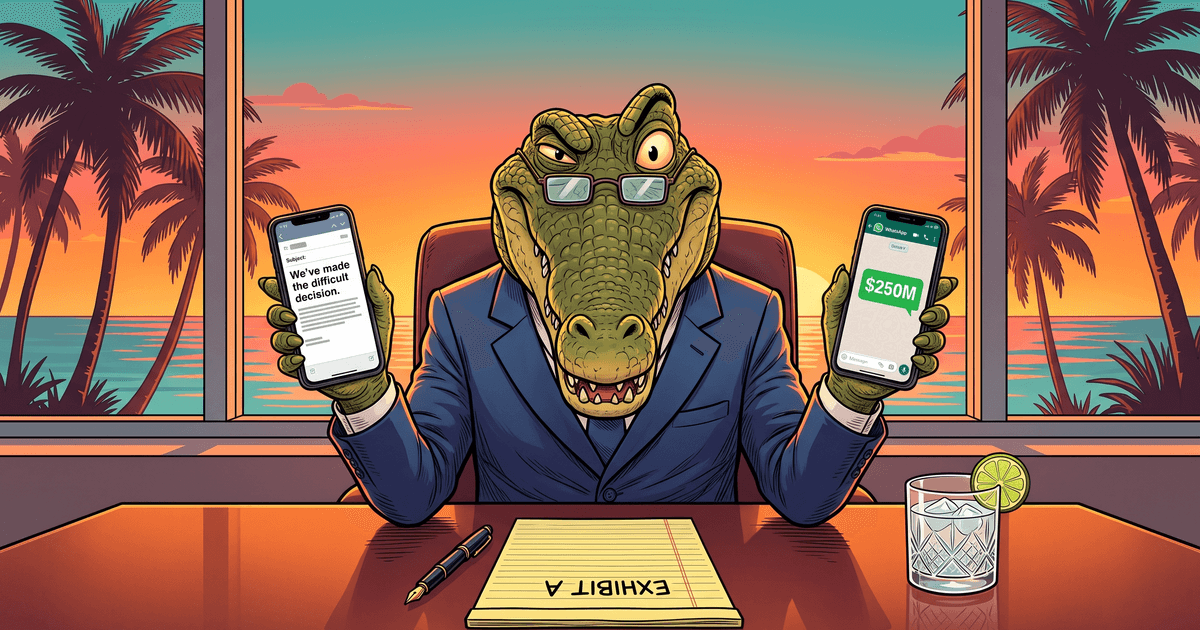
Now notice the jet. Zuck flew to Seattle to court a PhD dropout. Four months earlier, he’d fired 3,600 people by email. He did not fly anywhere for that. Did not get on a plane. Did not sit down personally. Did not double anything. The jet works one direction. The email works the other. Deep pockets, shallow loyalty. If you ever want to know where you stood at Meta, check which app they used to reach you. WhatsApp = you’re worth $250 million. Email = you’re worth a COBRA enrollment form. That’s your performance review. That’s the whole review.
The Costume Comes Off
But here’s where the costume drops and the whole viral number faceplants into its own headline.
That $250 million is a package. Multi-year. Heavily stock. Vesting over four years, contingent on the kid staying and Meta’s share price cooperating. It is not a briefcase of cash for signing your name on a Tuesday. The gap between “total compensation over four years including unvested equity that depends on a stock ticker” and “signing bonus” is the gap between “I own a house” and “I have a mortgage.” One sounds much better at dinner. Both are technically true. Only one cleared the bank. The other one is living rent free in every journalist’s head — and it didn’t even pay deposit.
Meta told Bloomberg and CNBC: no evidence of $100 million signing bonuses. None. Zero. Zilch. The number, they said, conflated multi-year comp with a single cash payment. CTO Andrew Bosworth didn’t bother with diplomacy — Altman, he said, was “just being dishonest here.” When the Wall Street Journal reported a package up to $1.5 billion for one researcher, Meta spokesman Andy Stone called it “inaccurate and ridiculous.” And then — chef’s kiss, no other words for it — the single best receipt in this entire saga: reporters attached a $100 million figure to three researchers Meta poached from OpenAI’s Zurich office, and one of those researchers — Lucas Beyer — went public and called it “fake news.” [AI CERTs]
The payer says no. The authorizer says no. The payee says no. Three nos. Zero confirmations. The number got caught in 4k and still nobody deleted the tweet. When the alleged beneficiary of your generosity calls the check fake news on the record, the check is doing something other than clearing. In twenty-four years of litigation, Sonny has seen a lot of disputed numbers. He has never seen a number denied by all three parties to the transaction and still printed as fact the next morning. That’s not reporting. That’s glazing a headline without checking the receipt. Get well soon, journalism.
The engineer has been working since the Bronze Age. The bonus was confirmed by nobody. But the headline was too good to check. Task failed successfully.
In defense of Sam Altman
He was losing people. Eight researchers crossed to Meta by June. When your house is being robbed you’re allowed to describe the burglars. But you’re not a neutral witness — you’re the victim giving testimony, on your brother’s couch, to an audience of millions, with no fact-checker and excellent lighting. Altman pulled a fast one on every outlet that printed it. Turned a talent loss into a PR win without spending a dollar. The performance was world-class. In Sonny’s prosecution: every journalist who printed “$100M cash signing bonus” without a single named source is now Exhibit B in the case of Journalism v. Bothering To Check. The vibes were immaculate. The sourcing was cooked. Court adjourned.
The Draft Class
The confirmed hires — the real ones, the ones with receipts — are still enormous. Zuck personally maintained “The List.” Not a headhunter’s list. Not HR’s list. Zuck’s personal hit list — eleven researchers to poach, first revealed by Fortune from an internal memo. Delivered by WhatsApp. Personal messages from a man worth $200 billion, tapped with his thumbs, on an app his company owns. In February he used email to fire 3,600 people. In June he used WhatsApp to recruit eleven. Same CEO. Same thumbs. Same fiscal year. One group: NPCs, fired by email, generic Tuesday morning. The other group: main characters, recruited by WhatsApp, personal attention from the CEO. The app is the message. The message is: you were never on The List. The List had eleven names. You had a mortgage. [Fortune]
The confirmed roster reads like an all-star draft gone fully unhinged. Shengjia Zhao — co-creator of ChatGPT and GPT-4, now running Meta’s Superintelligence Labs research agenda. Ruoming Pang — poached from Apple, package north of $200 million. Former GitHub chief Nat Friedman. The talent pool runs a few hundred to a few thousand people on the planet. When supply is that thin, the price gets stupid. That part is real. That part Sonny can’t argue with. Cope harder, economics textbooks.
OpenAI panicked beautifully. Chief Research Officer Mark Chen — running research at a $300 billion company — sent a memo. On a Saturday. At what Sonny imagines was roughly 2 a.m., two whiskeys deep, in a hoodie he hasn’t washed since Tuesday, rage-typing into Slack while his wife pretends to be asleep. Every great retention strategy starts with a man alone in the dark comparing his company to a crime scene. He wrote: “I feel a visceral feeling right now, as if someone has broken into our home and stolen something.” [TechCrunch]
A home invasion metaphor. From the head of research. At a three-hundred-billion-dollar company. On a Saturday. On Slack. Cry me a river, Mark. You know who else felt a visceral feeling? The 3,600 people who opened a Tuesday email in February that started with “We’ve made the difficult decision.” They felt a visceral feeling too. Theirs didn’t come with a retention bonus. Theirs came with a COBRA enrollment form and a reminder to return their badge. But sure — your Saturday Slack post about burglars is the real tragedy here.
Chen told the team OpenAI was “recalibrating comp” — which is HR for “throwing money at the wall before the wall leaves” — and looking for “creative ways to reward top talent” — which is HR for “we googled what OpenAI pays and added 20%.” He also drew a line: he wouldn’t retain people “at the price of fairness to others.” A home robbery, a bidding war, and a fairness lecture — all in one Saturday Slack post. That’s not a compensation policy. That’s a hostage negotiation with a diversity statement stapled to the ransom note. Absolute unit of a memo. When your retention strategy requires a home-invasion metaphor and it’s 2 a.m. on a Saturday, the talent hasn’t just left — the talent took the furniture, sold the couch on Facebook Marketplace, and used the proceeds to buy Meta stock. The memo is the goodbye card. You paid for the envelope.
The Billion That Walked Out the Door
So where’s the actual billion? Not in a paycheck. Not in a WhatsApp from Zuck. Not in a stock package with a four-year leash. The actual billion walked out the door on its own two legs, hailed a cab, and started a competing company. Like it always does.
Start with the one that should make Zuck sweat through his hoodie every time he thinks about it. In June 2025, Zuck dropped $14.5 billion to acquire Scale AI — mainly to install its CEO, twenty-eight-year-old Alexandr Wang, as Meta’s new chief AI officer. Wang had never run a research lab. Never published a research paper. Never won a scientific prize. Never peer-reviewed anything that wasn’t a cap table. Research credentials? Dog water. But he was twenty-eight, he was expensive, and Zuck wanted him. So Wang got the corner office, the title, and — critically — authority over Meta’s legendary FAIR lab. Including the man who built FAIR from nothing over twelve years. Including Yann LeCun.
Yann LeCun. Turing Award winner. Co-inventor of deep learning. One of three humans whose work made every AI product on Earth possible — including the ones paying Deitke $250 million, including the ones Altman was defending on his brother’s podcast, including the search engine you used to Google “how much does an AI researcher make” before clicking on this article. LeCun had run FAIR since 2013. He’d turned Meta into a serious research institution. By any measure, one of the five most important living computer scientists.
His new boss was twenty-eight and had never published a paper.
Have a seat, because this part is a masterpiece of corporate self-destruction. Zuck paid $14.5 billion for Wang. Put a twenty-eight-year-old with no research background in charge of a Turing Award winner who literally invented the field. Wang’s research credentials? Mid. His price tag? Not mid. His authority over a man with fifty years of citations? Weapons-grade delulu. It’s giving “the hospital fired the chief surgeon and put a business school graduate in charge of the operating room.” The business school graduate calls it operational efficiency. The surgeon calls it Tuesday. The patients call a lawyer. This ain’t it, chief. But in fairness, Wang had other qualifications. He was twenty-eight. He was confident. And he had $14.5 billion worth of Zuck’s attention — which, in Silicon Valley, is worth more than a Turing Award. Apparently.
LeCun lasted four months. In November 2025, he walked. His exit interview — given to the Financial Times, not to HR, because when you have a Turing Award you give your exit interview to the press — HR gets a form, the Financial Times gets the quote, the form goes in a drawer, the quote goes around the world — and it contained the single best line in this entire saga: “You certainly don’t tell a researcher like me what to do.” He didn’t slam the door. He flipped Meta the bird from across the Atlantic, removed the door from its hinges, took it with him to Paris, and used it as the front entrance to his own company. Standing on business. Didn’t look back.
By March 2026, LeCun’s new lab — AMI Labs — closed a $1.03 billion seed round at a $3.5 billion valuation. Largest seed round ever raised by a European startup. Backed by Bezos, NVIDIA, Samsung, Eric Schmidt, Mark Cuban. Every single one of them looked at the man Meta couldn’t keep and bet a billion on what Meta wouldn’t let him do. LeCun ate and left no crumbs.
One month later: David Silver, DeepMind’s AlphaGo architect, raised $1.1 billion for his own lab, Ineffable Intelligence, at a $5.1 billion valuation. Took LeCun’s record and broke it in thirty days. Google had spent years and untold millions trying to keep him. He left anyway. The retention package was a speed bump. The exit was a highway. [CNBC]
Meta fumbled the bag so hard the bag left the country. Zuck paid $14.5 billion to hire Wang. LeCun left for free and raised a billion in four months. If your personal finances did this — spent $14.5 billion on a new hire while the guy he replaced opened a competing shop across the street, raised a billion, and got backed by your competitors — your spouse would change the locks, hire a forensic accountant, and tell the judge about the hoodie. You love to see it.
The billion-dollar job doesn’t exist. The billion-dollar quitting does. You don’t get the money by taking the desk next to Zuck. You get it by walking out, slamming the door, and building the thing yourself — without a 28-year-old boss, without a Saturday Slack memo, and without 3,600 former colleagues wondering why the jet flew to Seattle but never flew to their severance meeting. The real signing bonus is the exit door. Always was.
"When computer scientists are paid like professional athletes, we've reached the climax of Revenge of the Nerds." — David Autor, MIT economist, to the New York Post
With respect, Professor: the nerds lapped the athletes two exits ago. LeBron James makes $50 million a year and has to show up every night and put a ball through a hoop in front of twenty thousand screaming people while getting fouled by a seven-footer. Deitke makes that in five months and trains a model in his pajamas. LeBron never turned down $125 million. Deitke did it on a phone call. While not finishing his PhD — which was going to teach him how to do research. Meta was going to pay him $250 million to do research. One of these paths has a stipend. The other has a Gulfstream. He chose correctly. While being twenty-four. The nerds aren’t just winning. The nerds are getting paid more to do less in front of fewer people, and nobody even knows their names. Revenge of the Nerds was supposed to be a comedy. Turns out it’s a documentary. And a prophecy.
ACT III — THE EFFICIENCY CIRCUS
2025 – 2026 · Fire for efficiency, bid for ambition, same fiscal year
Now for the act that earns this file its tent under the big top. This is the part where the same companies that were spraying nine figures at a handful of researchers were simultaneously firing everyone else and calling it — Sonny needs to put his drink down for this one — efficiency. Clown behavior of the highest order. Hall of fame material. This one’s going in the museum and they’re going to name a wing after it.
January 14, 2025. Zuck sends an internal memo. He’s “decided to raise the bar on performance management and move out low-performers faster.” The word “low-performers” is doing more heavy lifting in that sentence than any of the 3,600 people it was about to fire. It means: you are being terminated, we are telling the press it’s because you weren’t good enough, and we are doing it by email, on a Tuesday, four months before we fly a Gulfstream to Seattle to double a PhD dropout’s offer because $125 million hurt his feelings. [CNBC]
Those 3,600 people passed Meta’s interview process. Six rounds. Coding challenges. System design. “Culture fit” — whatever that means at a company whose culture changes every time the CEO reads a new book. Behavioral questions about how they handle conflict — which, in retrospect, did not include “how do you handle being fired by email while the CEO flies a Gulfstream to double someone else’s offer.” They passed all of it. They relocated. Their kids changed schools. Their spouses found new dentists. They updated their LinkedIn bios to say “Meta.” And then one Tuesday morning they opened an email that said they were low performers. Not “the role is being eliminated.” Not “we’re restructuring.” Low performers. The company put the word “low” on people it had spent six rounds selecting. That’s not performance management. That’s a company that overhired in 2021, can’t admit it overhired in 2021, and is blaming the people it overhired in 2021. The 3,600 weren’t low performers. They were evidence of low planning. Skill issue — but the skill issue is in the C-suite.
In defense of the 3,600
They were not low performers. They were low priority. Meta needed a story for the press — “cutting low performers” sounds like discipline, “we hired too many people during the pandemic gold rush and now we need their headcount for shinier people” sounds like what it actually was. Easier to call 3,600 people bad at their jobs than to admit the CEO’s hiring plan from 2021 was the real low performer in the room. When the company that hired you calls you a low performer, the company is grading its own homework. And it gave itself an A. F in the chat — for Meta’s self-awareness.
Four months later. June 2025. Same company. Same CEO. Different app. The List goes out — Zuck’s personal WhatsApp roster of eleven researchers to poach from OpenAI, Apple, and Google. WhatsApps. Not emails. Personal messages from the CEO, tapped with his own thumbs, on an app his company built and owns. In February he used email to fire 3,600 people. In June he used WhatsApp to recruit eleven. Same CEO. Same thumbs. Same fiscal year. The 3,600 got an email from HR. The eleven got a WhatsApp from Mark. 3,600 NPCs fired by email. Eleven main characters recruited by WhatsApp. If that doesn’t tell you everything about how this company sorts people, Sonny can’t help you. The app is the message. The message is: you were never on The List.
Then July 30. Zuck publishes a 616-word manifesto titled “Personal Superintelligence.” In it, he declares that “developing superintelligence is now in sight.” He does not define superintelligence. He does not say when. He does not say how. He does not mention the 3,600 people he threw under the bus six months earlier, or the 600 he’s about to fire three months later. Sir, this is a Wendy’s. “Personal Superintelligence.” Not “company superintelligence.” Not “team superintelligence.” Personal. The title tells you everything about who this manifesto is for. It’s not a strategy memo. It’s a LinkedIn post that escaped into the wild. What he does define is the budget: $66–72 billion capex. $114–118 billion total expenses. A $27 billion data center in rural Louisiana. And the punchline — the one Sonny keeps coming back to, the one that makes him put down his drink and pick up his reading glasses every single time — more than $10 billion, paid to Google’s cloud, over six years. [CNBC]
The company that just fired 3,600 people for “efficiency” was writing a ten-billion-dollar check to its oldest competitor to rent computers. Fire the humans — too expensive. Rent Google’s servers — sure, put it on the corporate card, ten billion over six. That’s like firing your gardener because you can’t afford him, then hiring your neighbor’s gardener at triple the rate. And your neighbor is the one who’s been trying to steal your clients for twenty years. That’s not penny-wise, pound-foolish. That’s penny-wise, ten-billion-pound-foolish. Tell me you didn’t read your own 10-K without telling me you didn’t read your own 10-K. All hat, no cattle. The audacity. Somewhere in Menlo Park, Zuck is sweating through his hoodie and hoping nobody does the math. Sonny did the math.
616 words about superintelligence without defining the word. Mission accomplished energy. A dumpster fire with a press release. Main character syndrome with a $118 billion budget. He drank the Kool-Aid, distilled it, bottled it, and sold it to shareholders at a premium. The manifesto didn’t just fall flat on its face — it faceplanted, bounced, and faceplanted again. The lights are on but nobody’s home. Who asked?
October: The Punchline
October 22, 2025. Meta fires approximately 600 people from its AI division. Not random contractors. Not the cafeteria staff. AI researchers. The people who built FAIR. The people who worked alongside LeCun for twelve years. The infrastructure engineers. The product teams. The people who were there before The List, before the WhatsApps, before the $14.5 billion Wang acquisition, before a 28-year-old who’d never published a paper became their boss and a 24-year-old PhD dropout became their $250 million colleague. Out the door. Every single one. But the small unit housing Zuck’s expensive summer draft class — Deitke, Zhao, Pang, the WhatsApp eleven — was pointedly, conspicuously, surgically spared. You can’t make this up. You literally could not write this as fiction because an editor would say “this is too on the nose.” [SiliconANGLE]
The memo came from Wang. Twenty-eight years old. No research publications. Running a lab that a Turing Award winner walked out of rather than report to him. Bless his heart. And Wang’s memo contained the single most Sonny sentence in this entire saga. He wrote that by shrinking the team, “each person will be more load-bearing.”
Load-bearing.
Load. Bearing.
Let Sonny sit with this word for a moment, because it deserves the full moment. It deserves a chair, a drink, and a view of the ocean.
Six weeks. Six weeks after paying a PhD dropout a quarter of a billion dollars. Six weeks after Zuck personally flew to Seattle, sat down with a kid who hadn’t finished school, and doubled an offer because $125 million wasn’t enough. Six weeks after all of that — a twenty-eight-year-old who’d never published a paper, who’d never run a lab, whose primary qualification was being expensive and young — told six hundred researchers they were “load-bearing.” On their way out. To the parking lot. Past the badge scanner that wouldn’t beep anymore. Past the free cold brew they’d never taste again. Past the all-hands screen where Zuck once said “we’re all in this together.” They were not all in this together. They were never all in this together. ‘All in this together’ is what CEOs say at all-hands the same way pilots say ‘slight turbulence’ when the oxygen masks drop. One kid got a WhatsApp and $250 million. Six hundred adults got a memo from a twenty-eight-year-old and a word — “load-bearing” — that they will remember at every job interview, every dinner party, every 2 a.m. thought spiral, for the rest of their careers. Clown behavior. There’s no other word for it.
One kid’s package ≈ the annual salary of the entire unit they gutted in October. Four Deitke packages ≈ the annual salary of all 3,600 “low performers.” The jet flew to Seattle. The email went to Palo Alto. The 28-year-old called them load-bearing. Efficiency. 🎪
In defense of Meta
The logic might be sound. Sonny hates saying it but honesty is the gig and saying it makes the next part hit harder. If only a few thousand people on Earth can build superintelligence and the prize is measured in trillions, then $250 million for one of them is a rounding error. Fine. Stipulated. But then own it. Say “we are replacing our workforce with a more expensive one because the old one can’t do what we need.” That’s ugly, but it’s honest. Instead, Meta called 3,600 people “low performers.” Stamped the word on them. Made the label public. Gave them a word they’ll have to explain in every job interview for the next five years — “it says here you were terminated for low performance at Meta” — while the company was simultaneously flying Gulfstreams and writing WhatsApps and paying $250 million to a kid who said no the first time. The spending is the strategy. The lie is the fumble. Meta fumbled the bag on honesty. Don’t call a bidding war “efficiency.” Don’t call a roster swap “performance management.” Don’t tell 3,600 people they failed when the failure was your hiring plan from 2021. The costume is the crime. Take it off. Everybody can see your hoodie underneath anyway.
Meanwhile, at Google: Somehow, Palpatine Returned
You think this was a Meta-only circus? Two miles down the road, Google was running the same play on a slow drip — the kind of leak where management keeps saying they fixed the faucet, the floor is underwater, and the plumber is on a yacht he bought with Google stock.
Voluntary buyouts in HR, February 2025. Cuts in Cloud. Same month. Buyouts across the 20,000-person Search-and-Ads division in June. More rounds through 2026 — Android, Chrome, Pixel. By trade-press count: 1,500 to 3,000-plus engineers separated in 2026 alone. While Cloud posted record revenue. While YouTube posted record revenue. While Search posted record revenue. The profitable divisions were firing profitable people. Speedrunning layoffs in units that were already printing money. Absolute unit of a self-own. Built different — at losing the plot. [CNBC]
And then the number that makes the entire “efficiency” costume fall to the floor, trip on its own pantleg, and faceplant into its own earnings call. After all the buyouts. After all the “difficult decisions.” After the CEO said the word “lean” at a podium, into a microphone, with a straight face, to shareholders who can read an SEC filing. After all of it — Alphabet employed 194,668 people at end of March 2026. Up from 185,719 a year earlier. Up. They fired and fired and fired and the headcount went up by nine thousand people. They added the population of a small town to the payroll while telling the press they were getting lean. Then guided to $175–185 billion in capex — more than the GDP of 140 countries. For context: if Alphabet’s 2026 capex were a country, it would rank between Kuwait and Hungary. Kuwait has oil. Hungary has paprika. Alphabet has a headcount problem it keeps calling ‘efficiency.’ Somehow, Palpatine returned. Narrator: it was not, in fact, lean. It was the opposite of lean. It was a company that couldn’t stop hiring wearing a costume that said “efficiency” in a font designed by the marketing team they’d also just fired. Curb your enthusiasm moment of the fiscal year. [Alphabet Q1 2026, SEC]
You were not watching a company shrink. You were watching it swap: fire the ones it had, hire the ones it wanted, call the swap “efficiency,” and pray nobody checked the headcount line in the SEC filing. Somebody checked. Sonny checked. The wheels didn’t just come off — they filed for independence, started their own lab, and raised a billion dollars. Caught in 4k.
The Bill
Who got bent over? Sonny will be specific.
Not the researchers. Deitke got $250 million. LeCun raised a billion. Silver raised a billion. The draft class is eating. The researchers will always be eating, because there are only a few thousand of them and every company with a GPU and a manifesto wants their number.
The people who got bent over are the ones who were in the building before the circus arrived. The 3,600 who got an email on a Tuesday. The 600 who got called “load-bearing” by a 28-year-old with no publications on their way to a parking lot they no longer had access to. The Google engineers who took a buyout from a division that was posting record margins. The people who passed six rounds, relocated their families, updated their LinkedIn, showed up every day for years — and then discovered that in the same fiscal quarter they were tagged “low performer” and shown the door, a kid who hadn’t finished his PhD was being flown to Seattle on a Gulfstream and handed more money than most of them would earn in ten lifetimes. They were never on The List. They were on the other list — the one HR sends on a Tuesday.
The billion is real. The job isn’t. The costume is spectacular. And the bill was handed to the people who never got the offer, never got the WhatsApp, never got a personal visit from Zuck, and never got to say no to $125 million. They got an email. On a Tuesday. From HR. The subject line started with “We’ve made the difficult decision.” Five words that mean “we’ve made the easy decision and we’re going to describe it as difficult so you feel respected on your way to the parking lot.” Nobody who writes that sentence found it difficult. The difficult decision was how much to pay the next kid — and whether to fly the Gulfstream or just send a WhatsApp. They sent both. The 3,600 got neither.
P.S. To the 3,600 people who were emailed on February 10, 2025, that they were “low performers”: Sonny checked. You were not low performers. You were low priority. There’s a difference, and it’s exactly $249.6 million. The kid who got the WhatsApp hadn’t finished his PhD. You had finished yours. He said no to $125 million. You would have said yes to keeping your desk. He wasn’t on the other list. You were never on The List. You were on the list that HR sends on a Tuesday. Sonny does not send flowers. Sonny sends receipts. 🐊
P.P.S. To Alexandr Wang, who called 600 researchers “load-bearing” on their way to the parking lot: how much load can a twenty-eight-year-old bear who never published a paper, never ran a lab, and got the job because Zuck spent $14.5 billion and needed someone to sit in Yann LeCun’s chair? LeCun’s in Paris now. He raised a billion. He’s backed by Bezos. He seems fine. Bless your heart. Send a postcard. 🐊
P.P.P.S. Meta’s internal values include “Move Fast.” They did. They moved 3,600 people out in February, moved $250 million to Seattle in June, and moved 600 more people out in October. Nobody at Meta can accuse them of not living their values. 🐊