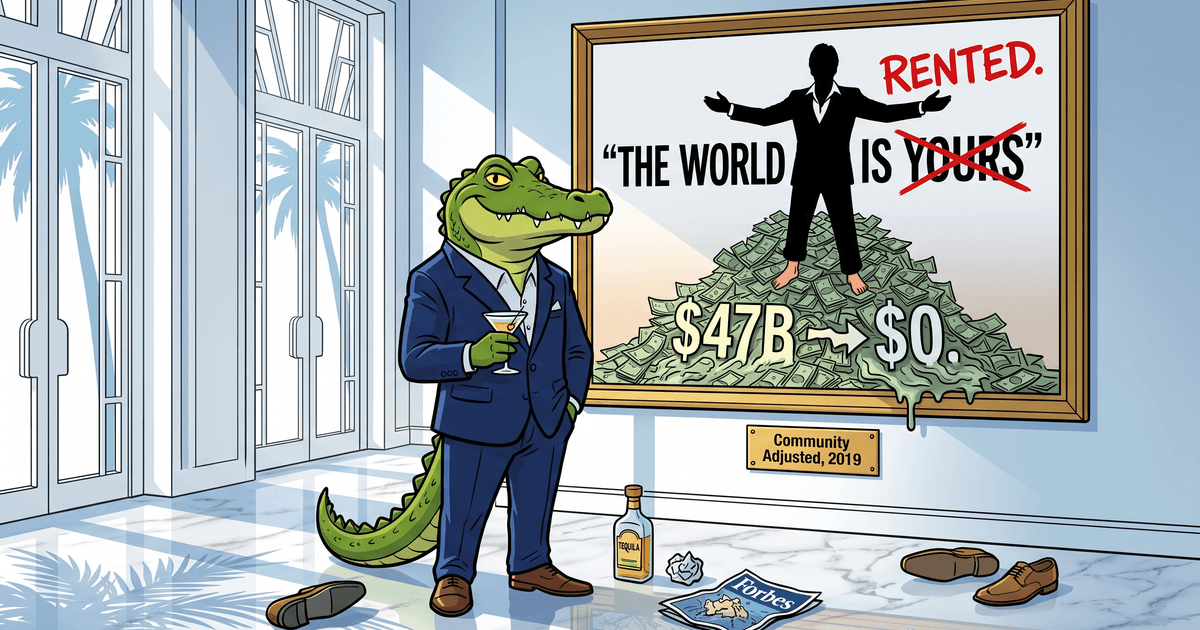
Sonny has spent twenty-five years in commercial and securities litigation on Miami Beach. He has read a great many related-party leases. He has watched three market cycles inflate and deflate from a corner office with a view of the water and a filing cabinet full of other people’s confessions.
In all that time, Sonny has never once seen a man invoice himself for a pronoun.
Pour yourself something. This is going to take a while, because they always do.
ACT I — THE PROPHET
2010 – 2019 · "Our mission is to elevate the world's consciousness."
Every great fumble begins with a story so good that the arithmetic forgets to show up.
Adam Neumann’s story was this: he was not renting desks. He was elevating the world’s consciousness. That is not Sonny being cute. That is the second line of a registration statement filed with the United States Securities and Exchange Commission. Two pages in, before a single financial figure, the document pauses for a benediction: it dedicates itself “to the energy of we — greater than any of us, but inside each of us.”
"Our mission is to elevate the world's consciousness." — The We Company, S-1 filing, August 14, 2019
Sonny has read a lot of prospectuses. A prospectus is supposed to be the least romantic document on Earth — a legally-mandated list of every way you might lose your money. This one read, in the diagnosis of the NYU marketing professor Scott Galloway, like “a novel written by someone who was ’shrooming.”
The man himself was a natural. Before WeWork he’d turned a line of baby clothes with knee pads sewn in (a real product called Krawlers, with the real slogan “just because they don’t tell you, doesn’t mean they don’t hurt”) into a company. He was raised on a kibbutz and told an Israeli newspaper his ambition was to build “a capitalist kibbutz.” Nobody stopped him. They funded him.
The 12-Minute Empire
Here is the meeting that funded the whole thing. By the accounts collected since, Masayoshi Son — the founder of SoftBank, the man whose $20 million bet on Alibaba once ballooned into roughly $200 billion, arguably the single greatest investment in the history of capitalism — arrived to see Neumann running about an hour and forty-five minutes late. So he told Neumann, by his own reported account: “I only have 12 minutes. Go.” When the time was up, Son had Neumann ride along to his next stop and sketched the deal on his iPad in the car. SoftBank would ultimately pour in something on the order of $18.5 billion. [TIME]
The most expensive small talk in the recorded history of finance. A man who found Alibaba on instinct set fire to a Vision Fund on the same instinct nineteen years later.
In his defense: even the whale admitted it
Sonny believes in giving even a whale his day in court, and Son did, eventually, say the quiet part out loud. “My investment judgment was poor in many ways,” he told reporters after the losses landed. Later he’d upgrade it to “foolish.” Then he removed himself from public view for something like eighteen months — which, for a man of his ambitions, is roughly the corporate equivalent of a monastery.
The prophet's greatest hits
To fund a chakra at a software valuation, you need a founder who can make a room of adults decide gravity is optional. Neumann could. He told a person close to the company, per New York magazine, that he needed the biggest valuation he could get, because — his words — “when countries are shooting at each other, I want them to come to me.” He is describing a co-working company as a future arbiter of international peace. Nobody stood up and left.
At an all-company event he reportedly announced that there were a hundred and fifty million orphans in the world, and that WeWork would “give them a new family: the WeWork family.” Sonny has nothing to add to that. As The Wall Street Journal documented in the reporting that pried the whole thing open, he walked the floor barefoot, blasting Rihanna; his tequila, Don Julio 1942, was kept stocked around the country for his visits; and on a Gulfstream G650 to Israel, according to people familiar with the flight, his group smoked marijuana and the crew later found a chunk of it stuffed in a cereal box for the return leg. The jet’s owner, reluctant to run cannabis across borders, recalled the plane and left Mr. Neumann to find his own way home.
In his defense: at least he was consistent about the carbon
In 2018 the company banned red meat, poultry, and pork from its offices “to leave a better world for future generations.” A man who bans a hamburger to save the planet, and then charters a G650 to smoke on the way to Tel Aviv, has at least achieved a perfect internal consistency. He was against carbon. Just not his carbon. None of this was illegal — it was the warning label. The scandal was on page 199.
ACT II — THE CON
The fifteen-year lease that called itself software
Here is what a “technology company committed to maximum global impact” actually did for a living. It signed long leases — in the United States, averaging about fifteen years — for large amounts of office space, renovated them, and rented them back out in month-to-month increments. That’s the company. It was a landlord. A stylish, barefoot, tequila-scented landlord, but a landlord.
Sonny wants to be precise about why this matters, because the whole $47 billion illusion rests on one sleight of hand. Compare it to Uber. Uber doesn’t own the cars — double the drivers and you roughly double revenue without doubling costs. That asymmetry is what “scalable” means, and it’s what tech multiples are supposed to be paying for. Now double WeWork’s tenants: you need to double your buildings. Costs rise in lockstep with revenue. There is no leverage. There is a charismatic man renting real estate at retail and selling it at a markup — a business as old as the pyramids.
We have a control group. IWG, formerly Regus, does the identical thing at greater scale and turns a profit; it was valued at roughly $3.7 billion. WeWork asked for $47 billion. The difference between those two numbers was not a business. It was a mission statement and a founder who could make you feel it in your chest.
The metric that deleted the bad parts
A company does eventually have to show numbers, even a company about consciousness. WeWork’s were catastrophic — a net loss of roughly $1.9 billion on about $1.8 billion of revenue in 2018. So it invented an outfit called Community Adjusted EBITDA, which deserves a plaque in the museum of creative accounting. As The Wall Street Journal described it, the metric subtracted not only interest, taxes, depreciation and amortization, but also basic expenses like marketing, general and administrative, and the cost of designing and building the spaces. [Axios]
By this logic Sonny is a billionaire, provided we agree not to count rent, staff, taxes, or the bar tab. The vibes are immaculate. The numbers are not.
The genius of it was that individual locations could be made to look “profitable” while the enterprise hemorrhaged cash by the billion. By the S-1 they’d quietly swapped in a friendlier “contribution margin” that did the same trick with better manners. Bloomberg gave the prospectus the only headline it deserved: the emperor’s new clothes. The word “community” appears roughly 150 times in the 220-page filing. The thing that mattered — $47.2 billion in future lease obligations against $4 billion of committed revenue — sat in the fine print, a long fixed liability funded by short cancellable income, waiting for someone to add it up. The public market simply read the document.
ACT III — THE PRONOUN
August 14, 2019 · The day the story became a document
On August 14, 2019, WeWork did the one thing a company built entirely on faith should never do. It published its books. For nine years it had been a story. On August 14 it became a document — and a document, unlike a story, cannot make you feel anything in your chest. It can only be read. The world read it in six weeks.
The pronoun invoice
Buried on page 199 were a couple of sentences that, once the finance world found them, could not be un-found. When WeWork rebranded to “The We Company,” it decided it needed to own the “we” family of trademarks. The problem: the entity that held those rights was a private vehicle controlled by Adam Neumann. So the company bought the rights — from its own CEO — and handed him, in exchange, stock worth about $5.9 million. He changed the name of the company to “We,” then charged the company $5.9 million for the name “We,” which he had made sure he personally owned. [CNBC]
Sonny has litigated related-party transactions for a quarter century. He has never seen a man bill his own company for a pronoun and call the price “fair market value.” That is not a conflict of interest. It is conflict of interest as performance art.
When the press found it, the money came back — “at Adam’s direction,” the amended filing noted, in the tone of a man returning to the buffet to quietly put the extra shrimp back. The company kept the trademark. But the point was made: the “We” in WeWork was a thing Adam Neumann sold to WeWork.
Every door was also self-dealing
The pronoun was not an aberration. It was the theme. He had taken ownership stakes in buildings — and then leased those buildings back to the company he ran. Landlord to the tenant, and the tenant was him. He controlled the company through super-voting shares — originally twenty votes per share, trimmed to ten under pressure, but ten was enough that Neumann could fire the entire board himself. And the S-1 wrote his wife, Rebekah, into the process of choosing his successor. (Sonny will be precise, because precision is how you stay un-sued: the filing did not simply crown her CEO, as some retellings have it — it wrote her into the selection.) The market’s reaction was swift enough that within weeks she was removed from succession and barred from the board.
Rebekah held the title Chief Brand and Impact Officer, took no salary per the filing, and ran WeGrow — a for-profit private elementary school for children ages two to eleven, with tuition running from $26,000 to $48,000 a year, roughly the price of an elite university, built around “unleashing every child’s superpowers.” As reported by The Wall Street Journal, former staff described her ordering people fired after brief encounters because she didn’t like their “energy.”
In the company's defense: the energy was applied evenly
At least the energy-based terminations were consistent. The husband ran the floor barefoot with a glass of tequila. The wife read auras. Somewhere in that building, a Fortune 500 company was renting a conference room.
ACT IV — THE UNDRESSING
September – October 2019 · $47 billion to nothing anybody would touch
By late September the offering was dead. The marketed valuation had slid from $47 billion to twenty-something, then to fifteen or less, then to nothing anybody would touch.
The one man who said it out loud
Every board has a conscience, even if it’s outvoted. WeWork’s was Bruce Dunlevie of Benchmark, whose firm had led the Series A in 2012 and owned around nine percent. When Neumann pushed for the voting-control structure that would make him untouchable, Dunlevie pushed back. His warning was four words long and about two thousand years old:
"Absolute power corrupts absolutely." — Bruce Dunlevie, Benchmark, to the WeWork board (as reported)
He was right. He was also outvoted — the board approved the super-voting and the stock sales, and Neumann got everything he asked for. The irony is load-bearing: Benchmark is the same firm whose Bill Gurley helped push Travis Kalanick out of Uber in 2017 over exactly these questions. The firm knew the movie. It had directed the movie. And with WeWork it sat in the theater and let the barefoot man run the projector. Asked later why he hadn’t worried about the numbers, one investor said, per Reeves Wiedeman’s book, that he’d had a feeling “you couldn’t quite put your finger on.” That, your honor, is the entire due-diligence file.
The parachute to nowhere
The final days, as reconstructed in The Cult of We, played like a farce. Jamie Dimon of JPMorgan — one of Neumann’s own bankers — made it plain the IPO could not go forward with Neumann as CEO. At one point Neumann ran into Dimon’s office looking for an ally and found the most powerful banker in America aligned against him. His own advisers told him at a late dinner: he had lost the board. Fight it, and the company runs out of money in weeks and his shares go to zero, taking his personal loans with them. So he left. And here is the part that should make anyone who ever held expiring options put down their coffee: SoftBank offered him up to $1.7 billion to walk away — roughly $1 billion for his shares, a $185 million consulting fee, and a $500 million loan facility. [CNBC]
You had one job, Sonny wants to say. And the job was to stop having that job.
For the record, since the internet loves to garble it: the consulting fee was $185 million, not $245 million, and the $1.7 billion was the exit package, not a pre-IPO cash-out. The pre-IPO cash-out was a separate, earlier ~$700 million he’d pulled through share sales and loans while the company was already losing money every quarter. Sonny keeps his numbers clean; they’re the only thing in this story that doesn’t lie. Even the parachute has a punchline: a year later SoftBank’s Marcelo Claure said the consulting agreement was “no longer in effect” because Neumann had allegedly violated it, and that he hadn’t received the full amount. Meanwhile the company laid off 2,400 people — a fifth of the staff — many holding options granted at the $47 billion mark. He got $185 million to leave. They got a Zoom invite two hours before a meeting, and a parking lot. [NBC News]
ACT V — SOMEHOW, PALPATINE RETURNED
2020 – 2026 · The bankruptcy, and the bigger check that followed
Here is where most fumbles end. The founder is disgraced, the money is gone, the credits roll, everyone agrees to Learn Important Lessons. Here is where this one keeps going, and gets worse, and becomes the reason Adam Neumann is a Founding Member of this Club rather than a footnote.
The wreckage, for the record
A real estate veteran named Sandeep Mathrani did the unglamorous adult work — cut over $2.3 billion in recurring costs, grew revenue — and it didn’t matter, because you cannot manage your way out of a fifteen-year lease book funded by month-to-month income. The pandemic emptied the offices. In 2020 the company lost another $3.2 billion. In 2021 it limped public through a blank-check merger at roughly $9 billion. Then came a one-for-forty reverse split, a “substantial doubt” warning, and on November 6, 2023, Chapter 11 with $19 billion in liabilities. [Bloomberg]
$47B → ~$120M. That is not a fumble. That is a negative-profit speedrun. Any percent.
The company was bought out of bankruptcy for around $450 million by a software firm called Yardi and survives today as a shell of itself. SoftBank lost most of its $18.5 billion. And Adam Neumann? At the moment his company declared bankruptcy, having lost his investors and employees billions, he was — per the Bloomberg Billionaires Index — still worth around $1.7 billion. He’d extracted so much on the way up that the crash couldn’t touch him. The building burned. He’d already moved his furniture out, and billed the movers to the company. [Fortune]
The $350 million standing ovation
You’d think presiding over one of the great value-destructions in modern business history would make a person, for a while, un-fundable. In August 2022 — while WeWork was still publicly traded, still bleeding, still fifteen months from bankruptcy court — Andreessen Horowitz handed Adam Neumann $350 million for a brand-new residential real estate company called Flow, valuing it at over a billion dollars before it had launched a single building. It was the largest single check a16z had ever written. In the blog post announcing it, Marc Andreessen explained his reasoning. Read it in the original: [Commercial Observer / NYT]
"...only one person has fundamentally redesigned the office experience..." — Marc Andreessen, on why he backed Adam Neumann, August 2022
He went on to call Neumann a visionary who had “revolutionized” commercial real estate, and to note that the firm loves backing repeat founders building on their past successes. Past successes. WeWork lost eighteen and a half billion dollars and filed for bankruptcy fifteen months after that sentence was written. Build on what, exactly — the bankruptcy, or the barefoot? Asked onstage how they justified it, a16z partner Chris Dixon offered a defense for the ages: “We do our own research.”
Not everyone found it charming. The investor Kathryn Finney called the news “a slap in the face,” and brought the receipt that lands the whole story: that single $350 million check — one man, one round — was larger than the $324 million raised by every Black-founded startup in the United States combined that quarter. [Fortune]
The lesson of WeWork, faithfully applied: you can incinerate a Vision Fund and get a bigger hose for the next building — provided you’re the right man, holding the right vibe, standing barefoot in the right room.
The sequel got a bigger budget
Here is where the file stopped making sense and started making Sonny laugh out loud in a quiet office. You would assume $350 million was the ceiling — the one absurd cheque, the fluke, the thing a chastened firm quietly walks back. It was the floor. By April 2025 — eighteen months after WeWork’s bankruptcy, with the corpse still warm in a Delaware courthouse — Flow had more than doubled to roughly $2.5 billion, and Andreessen Horowitz did not flinch and back away. It leaned in. a16z bumped its stake from 20% up to 25%, threw in another hundred million, and Neumann told Bloomberg he was “sure” Flow was a company that could go public “one day.” Sure. The man who took one company public into a $47-billion-to-nothing crater is sure about the next one. Sonny is sure too. Sonny is just sure of a different number. [Bloomberg]
Asked about the timeline, Neumann delivered the single funniest sentence in the entire sequel: “We don’t need to rush.” That’s the man whose last prospectus read, per an NYU professor, like it was written on mushrooms — now preaching patience. He has learned one lesson from WeWork. Exactly one. He learned not to rush. He did not learn the other thing — the thing about whether a landlord is a technology company — but he learned the tempo. Growth mindset.
"Physical spaces that unlock human potential now matter more than ever, especially in a world of increasing digital abstraction." — Marc Andreessen, doubling down on Flow, 2025
Read that quote twice, because it is not an investment thesis. It is the WeWork S-1 with the serial numbers filed off. “Physical spaces that unlock human potential” is “elevate the world’s consciousness” wearing a slightly cheaper suit. The same man, selling the same chakra, to the same firm, that already lost on the identical pitch once — and the pitch still lands. That is the whole engine of this story in one sentence: in a world of “increasing digital abstraction,” the one thing that has never once abstracted is Adam Neumann’s ability to make Marc Andreessen feel something in his chest. The consciousness is back. It just re-branded as “multifamily.”
It has gone so far past business that it has entered academia. There is now a peer-reviewed paper — Cambridge, Finance and Society, 2026 — with the actual title “The non-death of Adam Neumann: Alt-exiting, serial-founding, and failing up in Silicon Valley venture capital.” When your career becomes a literature-reviewed case study in how consequences decline to apply to you, you have transcended the fumble and become the syllabus. And the press has finally, quietly, dropped the costume it spent nine years humoring: Curbed now calls him, flatly, in a headline, “megalandlord.” He spent nearly a decade insisting he was not a landlord. The world stopped arguing and just added a prefix. The suit came off — not because he removed it, but because everyone simply stopped pretending they couldn’t see the fifteen-year leases underneath. [Cambridge, Finance and Society]
And then the flourish, the most Sonny-shaped detail in the file. In early 2024, as WeWork sat in bankruptcy court — the company he had built, inflated, self-dealt, and been thrown out of — Neumann, through his new venture, put in a bid of more than $500 million to buy it back. The arsonist returned to the smoking lot with a checkbook, to bid on the insurance claim. He has never, in any of it, publicly apologized. When the bankruptcy hit, his statement was that it was “disappointing,” and that it had been “challenging for me to watch from the sidelines.” Not a word of contrition. A performance review of the people cleaning up after him.
P.S. — a brief note to the Limited Partners of a certain venture firm. When your general partner describes an $18.5 billion bankruptcy as a “past success” your money should “build on,” that is not a thesis. It is a tell. Sonny isn’t saying don’t invest. Sonny is saying: do your own research. Somebody at that firm apparently already did, and look how it turned out. 🐊