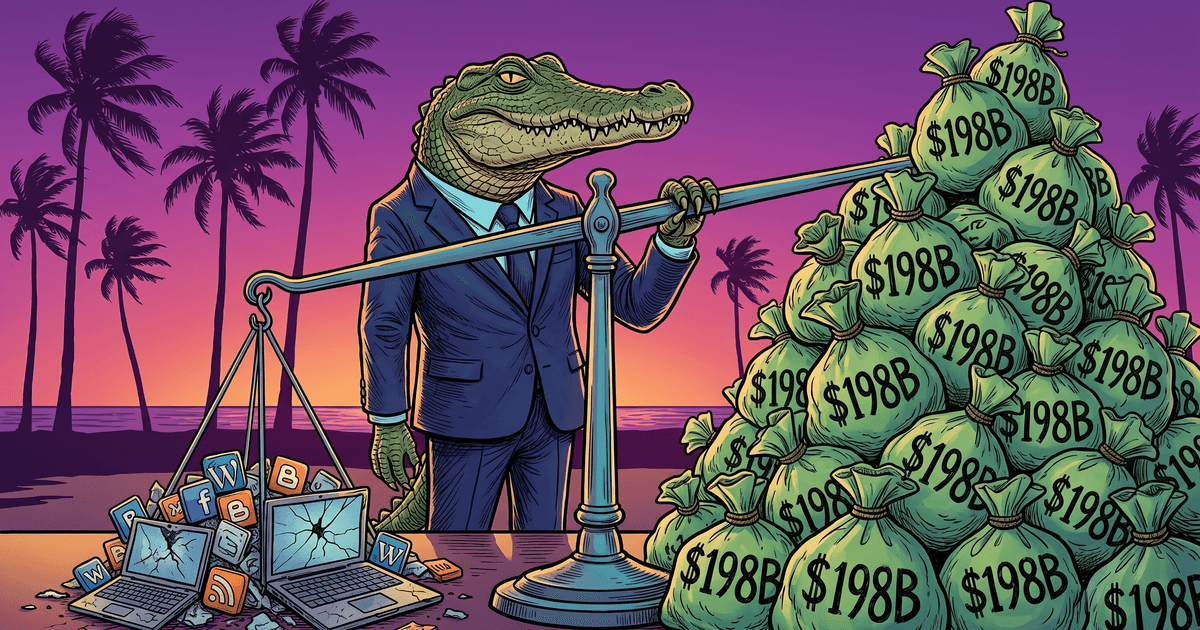
Sonny keeps the receipts, and this one is the biggest receipt he has ever filed — because for once the victim is not a company. It’s a commons.
Every article in this Club so far has been one operator bending one set of people over one bad decision. A faked blood machine. A truck that rolled downhill. A hedge fund that met a margin call at its own wedding. This file is different. This time the party being folded in half, without ceremony and without lubricant, is the entire open web — every recipe blog, every product-review site, every forum, every encyclopedia, every small writer who ever put words on a page hoping a stranger would find them.
And Sonny has to be honest with the jury up front, because he is an officer of the court and this is the point that makes the whole thing so maddening: nobody here committed a crime. No one is going to Terminal Island. A federal judge has ruled the defendant an illegal monopolist — that part is real, and Sonny will get to it — but the specific weapon in this file, AI Overviews, is, for the most part, perfectly legal. That is not a mitigation. In the Bent Over Club, doing something this consequential entirely within the law is not an excuse. It’s an aggravating factor.
Pour a tall one. Chapter 2 is the big one.
ACT I — THE PROMISE
May 2024 · One AI answer, pasted above every blue link.
In the last chapter of these Chronicles, we watched Reddit do something almost admirable in its honesty: it looked at the pile of content its users had written for free over eighteen years and sold it to Google for about sixty million dollars a year. [Reuters] The users were furious. Reddit was unbothered. But whatever you think of that deal, Reddit at least got a number, a contract, and a check.
This chapter is about the millions of websites Google didn’t offer a check. Because there is a second way for Google to get the world’s content, and it doesn’t cost sixty million dollars. It costs nothing, and it is called AI Overviews.
What the machine actually does
Here is the mechanism, in plain English, because the whole case lives in it. Google’s crawler indexes the web — your site, everyone’s site — the way it always has. When you search for something, Google’s systems now frequently decide that instead of just showing you a list of blue links, they’ll have Gemini, Google’s AI, write you an answer — an “AI Overview” — and paste it at the very top of the page, above every organic result. The answer is generated from the indexed pages: your words, run through Google’s model, served in Google’s font, under Google’s logo. There is a little row of source links. You already know how often anyone clicks them. [Wikipedia]
Google announced the experimental version — clumsily named “Search Generative Experience” — at its developer conference in May 2023. On May 14, 2024, it rebranded the thing as AI Overviews and switched it on for everyone in the United States. [Google I/O 2024 blog] By 2026 it reaches more than two and a half billion people a month, and Google has begun folding it into an even more total product called AI Mode, which crossed a billion monthly users by May 2026. [SQ Magazine]
The promise, for the record
Now — Sonny is “defending” Google in this piece, so let him present the defendant’s own words, because Google made a very specific promise on the day it launched this thing, and Sonny wants it entered into evidence before the numbers arrive. In its official announcement, Google wrote:
"With AI Overviews, people are visiting a greater diversity of websites for help with more complex questions. And we see that the links included in AI Overviews get more clicks than if the page had appeared as a traditional web listing for that query." — Google, official I/O 2024 announcement, May 14, 2024
More clicks. A greater diversity of websites. Google, under oath of its own blog, told the publishers of the world that this machine would be good for them — that being cited inside an AI Overview would send them more traffic than a plain old number-one ranking. Sundar Pichai stood on the I/O stage and called it a transformation. Remember that promise. Sonny is going to hold it up against the data in Act II, and the two are not going to be on speaking terms.
Because here is the scale we’re talking about. Google runs roughly 90% of all searches on Earth [StatCounter] and, by its own 2025 disclosure, handles more than five trillion searches a year — about fourteen billion a day. [Axis Intelligence] When a company with 90% of the world’s front doors changes what happens when you knock, it isn’t a product update. It’s a change to the physics of the internet.
Users genuinely like AI Overviews. Getting the gist of a boring question without clicking through nine SEO-bloated recipe pages that each open with a thousand-word memoir about the author's grandmother is, frankly, a nice experience. Nobody misses those pages. And Google didn't invent the "answer without a click" — it had Featured Snippets and Knowledge Panels for a decade; the zero-click web was already creeping up long before Gemini showed up. The AI Overview is, in one honest sense, just the search engine getting better at the thing search engines are for: answering the question.
But here’s who paid for the answer. The AI Overview is only as good as the web it’s summarizing — and the web it’s summarizing was built by people who were promised a click in exchange for the work. Google kept the summary and quietly stopped delivering the click. That’s not a better search engine. That’s a magician who improved his act by no longer paying the person who saws the lady in half.
ACT II — THE MASSACRE
2024–2026 · The click quietly disconnects from the open web.
Google promised more clicks. Let’s go to the tape. And a note on method, because the defendant is litigious and Sonny cites carefully: no single study proves everything, so here are several, each measuring a different thing, and they all point the same way.
The one percent
The cleanest, most methodologically sober number comes from the Pew Research Center, published July 2025 — not a survey, but the actual browsing behavior of 900 US adults across 68,879 real Google searches in March 2025. [Pew Research Center] Here is what Pew found:
When an AI Overview sits on the page, the click-through to an actual website is roughly halved — 8% versus 15%. [Search Engine Land] Google’s response to this study, by the way, was to call Pew’s methodology “flawed.” Pew, having simply watched what people actually did in their own browsers, declined to retract reality. [seo-kreativ]
The vanishing click
Zoom out from AI Overviews to the whole search page and the picture gets starker. The gold-standard measurement of “zero-click” searches — queries that end without a click to any outside website — comes from Rand Fishkin’s SparkToro, using clickstream data. In 2024, 58.5% of US Google searches ended with no click to the open web. By early 2026, that had climbed to 68% — the fastest acceleration in a decade, which SparkToro attributes largely to AI Overviews. [SparkToro]
And for the sites that do still rank, the top spot isn’t what it was. Ahrefs, studying 300,000 keywords, found that when an AI Overview appears, the click-through rate of the number-one organic result fell 34.5% in April 2025 — and, when they re-ran it in December 2025, 58%. Position two loses ~51%; even the tenth result loses ~19%. [Ahrefs data via llmrefs] The consultancy Bain & Company estimates organic web traffic has fallen 15–25% across many sectors. [Bain via omnibound] Gartner predicted a 25% drop in traditional search volume by 2026, and reality has been racing to meet it.
The most-cited site on Earth is losing its humans
Now the number that Sonny thinks is the whole story in miniature. AI Overviews cite sources; the single most-cited source across all of them is Wikipedia. Non-profit. Volunteer-written. The reference desk of the entire species. And in 2025, Wikipedia’s human pageviews fell about 8%. The Wikimedia Foundation went looking for the cause and found something bleak twice over: a springtime “traffic spike” it had recorded turned out, once its bot-detection was upgraded, to be mostly AI crawlers scraping the site — not people. Fewer humans, more bots. Marshall Miller of the Foundation said it plainly:
"Search engines are increasingly using generative AI to provide answers directly to searchers rather than linking to sites like ours." — Marshall Miller, Wikimedia Foundation, 2025
Sit with the shape of that. Wikipedia is the best-case scenario — it has no ads to lose, it survives on donations and volunteers. And even it is watching the machine drink from its well while the humans who refill the well stop showing up. [Pew] Now imagine you’re not Wikipedia. Imagine you’re a person who reviews air purifiers for a living, or writes about regional cooking, or explains tax law for beginners — someone whose rent depends on that click. That’s the massacre. It doesn’t make a sound. It just shows up as a line on a traffic chart that only goes one way.
One honest caveat, because Sonny doesn’t cook the books: not every traffic collapse of the last two years is AI Overviews’ fault. Google’s separate “Helpful Content” updates flattened thousands of independent sites starting in 2023, before AI Overviews had teeth; the coding forum Stack Overflow began shrinking in 2022, mostly because of ChatGPT, not Google. Sonny won’t pin every death on this one weapon. He doesn’t have to. The aggregate is enough: fewer than a third of searches now reach a website, and the trend line is a cliff.
ACT III — EAT ROCKS
May 2024 · The machine that replaced the writers can't tell a joke from a fact.
Sonny needs to lighten the mood before the greed section, and Google has generously provided the material. Because here is the exquisite part: the machine that Google decided should replace the humans who write the web is, on the evidence, a moron.
The glue and the rocks
Within days of the May 2024 launch, users searching how to keep cheese from sliding off a pizza received, from Google’s authoritative AI, the following culinary tip: add “about ⅛ cup of non-toxic glue” to the sauce. The source? An eleven-year-old joke comment on Reddit, posted by a user named — and Sonny is quoting the historical record — “fucksmith.” [Seeking Alpha]
Then, asked how many rocks a person should eat per day, the AI Overview advised “at least one small rock per day” for vitamins and minerals — laundering a gag straight out of The Onion. [The Register] It also, in various documented instances, framed smoking during pregnancy as fine. Google’s head of Search, Liz Reid, wrote a mea-culpa post — “About last week” — conceding the results and blaming the model’s inability to handle sarcasm:
"Forums are often a great source of authentic, first-hand information, but in some cases can lead to less-than-helpful advice, like using glue to get cheese to stick to pizza." — Liz Reid, VP of Google Search, "AI Overviews: About last week," May 30, 2024
Reid said Google made “more than a dozen technical improvements,” limited how much satire and forum content the AI would swallow, and restricted AI Overviews for health topics. [Google blog] To be fair to the defendant: no one is known to have actually eaten glue-pizza and been hospitalized, and Reid correctly noted some viral screenshots were faked. The rocks and the glue, however, were genuine.
The sixty-million-dollar punchline
And here — Sonny promises he did not arrange the universe this way, it simply is this way — is where Chapter 2 shakes hands with Chapter 1. Google paid Reddit sixty million dollars a year for its content. And the very first thing the world watched that content teach Google’s AI was an eleven-year-old’s joke about putting glue on pizza, served as cooking advice to the same public Google is busy diverting away from actual food writers.
Sixty million dollars, Your Honor, to discover that “fucksmith” is not a food scientist.
Now stop laughing, because here’s the turn. This is not a story about a funny bug that Google patched. It’s a story about judgment — Google’s judgment. This is the machine that Google has decided is good enough to stand between the entire human race and the entire written web, answering first, so the humans who actually know things get a one-percent tap. The same machine that thinks you should eat a rock. Google didn’t just build an unreliable narrator. It promoted him to editor-in-chief of the internet and fired the writers to pay for it.
ACT IV — THE TRAP
Sept 2023–2026 · An opt-out that only works if you agree to disappear.
By now a reasonable person asks the obvious question: if this is killing your traffic, why don’t the websites just tell Google to stop? Opt out. Pull your content. Refuse to feed the machine. And the answer to that question is the coldest thing in this entire file.
The decoy
Google, to its credit, offered publishers an opt-out control back in September 2023, a robots.txt token called Google-Extended. Media companies added it. They believed they had opted out. Here is what Google-Extended actually does, per Google’s own documentation: it stops your content from being used to train Gemini. That’s it. It does not stop your content from being used in AI Overviews — because AI Overviews aren’t built from the training data, they’re grounded in the live Search index, the ordinary one that Googlebot has always crawled. [ALM Corp]
So the “opt-out” everyone reached for was aimed at the wrong weapon. As Harvard’s Nieman Lab put it after examining Google’s own statements: there is no way for a publisher to block their content from AI Overviews specifically while staying in normal search. The only way to opt out of AI Overviews was to opt out of Google Search altogether — to tell Googlebot to leave and accept total invisibility to 90% of the searching world. [Nieman Lab]
"Google uses a single crawler to both index websites for traditional search and train its AI models. Publishers cannot opt out of one function without losing the other." — Adweek, on the AI-Overviews opt-out bind, 2026
That is not a choice. Sonny has read a lot of contracts, and this is a specific genre of document. It’s a ransom note. “Let us summarize your work and keep your readers, or vanish from the internet.” Pay the toll or cease to exist. The toll is your traffic; the alternative is your traffic. There is no third door.
The document Google didn't want read aloud
How deliberate was the decoy? We know, because of Google’s own antitrust trial. During the remedies phase, a Justice Department lawyer put an internal Google document from August 2024 into the record. According to that document, when Google built a training dataset, it removed 80 billion of 160 billion “tokens” — snippets of content — after filtering out material that publishers had opted out of. [Nieman Lab]
The publishers suing Google say this is the mechanism itself. In its September 2025 complaint, Rolling Stone’s parent alleges that “even when publishers have chosen to opt out of training Google’s AI products … Google still trains its search-specific AI products, including AI Overviews, on [our] content.” [Penske v. Google complaint]
In Google's defense: nobody is forced to be in Google
The defense’s cleanest line is: no one is required to let Google crawl them; the door is open; leave whenever you like. Technically true — and technically the emptiest sentence in the file. When a single company controls roughly 90% of how humanity finds anything, “you’re free to leave the index” is “you’re free to stop existing commercially.” A monopoly’s exit is not a choice; it’s a cliff with a courtesy railing. Which is, conveniently, exactly what a federal court has now ruled Google is.
ACT V — THE RECKONING
2024–2026 · Revenue up, web down, a monopoly excused by its own weapon.
So let’s total the ledger, and then let’s talk about the law — because this is where “legal” stops being a defense and starts being the indictment.
Revenue up, web down
Here is the fact that should be printed on the cover of every Google earnings report. As the clicks to publishers fell, Google’s search-advertising revenue — the money it makes from ads on the very results page where it’s answering your question for free — went up. Every year. Per Alphabet’s own 10-K: Google “Search & other” revenue was $175 billion in 2023, $198 billion in 2024 (up 13%), and roughly $224 billion in fiscal 2025. [Statista / Alphabet 10-K] Alphabet’s total revenue crossed $350 billion in 2024 and $400 billion in 2025.
Sonny wants to be scrupulously fair here, because the defendant’s lawyers will pounce: AI Overviews are not the only reason search revenue is up, and Google still does send publishers real organic clicks — the harm is reduced traffic, not zero traffic. Fine. Noted. But the direction is the whole scandal: Google is monetizing other people’s content more while sending its creators less. The well is being pumped harder and refilled slower, by the same hand, on purpose.
The law arrives, and shrugs
Now the part that elevates this from “sad” to “how is this allowed.” On August 5, 2024, Judge Amit Mehta of the federal court in Washington ruled that Google had illegally maintained a monopoly in search — a landmark finding after a nine-week trial. [Courthouse News] “Google is a monopolist,” the judge wrote, “and it has acted as one to maintain its monopoly.”
And then, in the remedies ruling of September 2, 2025, the same judge — facing the question of what to actually do about it — declined to break the company up. No forced sale of Chrome. He banned some exclusive default deals and ordered Google to share certain data with rivals, but the structural blow never landed. The reason he gave, and Sonny had to read this twice, was in part the rise of new competition in AI. [PPC Land]
Read that irony until it draws blood. The monopoly was spared the axe partly because of AI — the very technology Google is using, via AI Overviews, to make visiting a competing website unnecessary in the first place. The weapon that hollows out competitors was cited as evidence that competition is fine. Google built the machine that makes rivals pointless, and the machine’s existence became the reason not to punish the monopoly. You don’t need to pay to be the default door if you’ve bricked up every other door in the hallway — and then the court points at the bricks and says, “look, so many doors.”
The web hires lawyers
The publishers aren’t waiting for the government. In February 2025, the education company Chegg sued Google, saying AI Overviews gutted its traffic and revenue as its stock collapsed. [ALM Corp] Then, in September 2025, Penske Media — the parent of Rolling Stone, Variety, Billboard, and The Hollywood Reporter — filed a 101-page antitrust suit, the first to tie Google’s AI products directly to its court-proven search monopoly. [TechCrunch] Their theory is a 1960s antitrust doctrine called “reciprocal dealing”: you must hand Google your content to be allowed in its search results. Both suits allege, not prove — this is live litigation, and Sonny says “allege” on purpose.
Jay Penske put the stakes in a sentence: his company had “a responsibility to proactively fight for the future of digital media and preserve its integrity — all of which is threatened by Google’s current actions.” A travel blogger named Nate Hake put it in five words on X: “Google’s AI Overviews = theft.”
The fix that arrived after the getaway
And then, right on schedule — the Club has seen this ending many times — Google fixed it. After two years of the decoy, after the CMA in Britain publicly called Google-Extended too murky to be a real choice, after Chegg and Penske and the headlines, Google finally opened a genuine AI Overviews opt-out toggle for publishers in June 2026, plus a report showing how their content performs in AI answers. [The Keyword] Two years too late, immediately after getting caught, sued, and regulated. Whether opting out now just means “vanish from the AI answer while staying buried below the fold,” nobody yet knows — the toggle is too new to have data. But the timing tells you everything about what the previous two years were.
P.S. — a note to the next writer wondering if it’s worth publishing. Yes. Publish anyway. The machine can only summarize what already exists, which means it will always be one step behind the person who actually knows something new — and it will always, eventually, need you again. Sonny’s whole Club is built on documenting people who thought they’d never need the folks they stepped on. Google is about to learn the same lesson in the mirror: starve every writer on Earth, and the last thing your AI has left to read is the rock-eating advice it wrote yesterday. 🐊