ACT I — "COME BACK WITH A VODKA"
1919 – 1997 · A Connecticut onion farm to the most expensive bottle in America
The file on Sidney Frank should not, by any reasonable reading, end in two billion dollars. It should end in a modest obituary.
Kid off a Connecticut farm, up before sunrise pulling onions. Made it to Brown University and lasted exactly one year before the tuition money ran out and the door hit him on the way to the war, where he spent the 1940s rebuilding aircraft engines in India. He backed into the liquor trade the way a lot of men did in those days — he married into it, wedding the daughter of a distilling magnate after, by his own telling, she accepted his sixth proposal. And he built his first real fortune not on some ancient noble spirit but on Jägermeister — a German digestif that tastes like a cough drop with a grudge — by sending squads of young women into college bars to pour it down the throats of eighteen-year-olds. Effective. Not exactly Cordon Bleu. [New York Magazine]
And then, at 77 — an age when most men are entering delicate negotiations with a cardigan — Sidney Frank decided he was going to sell the most expensive vodka in America.
Sonny would like you to sit with the arithmetic of that. Seventy-seven years old. Never distilled a drop in his life. Walking into the one category of liquor the federal government legally defines as having no taste, no smell, and no color — a product whose entire regulatory identity is nothing — and the plan was to charge more for it than anyone ever had.
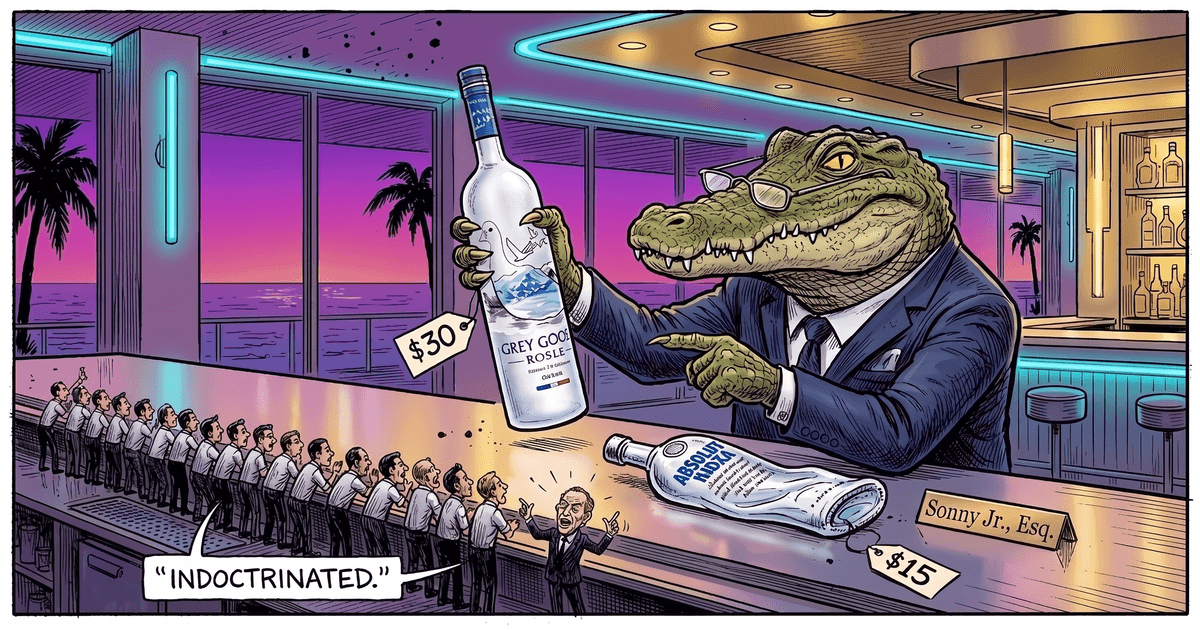
The year is 1997. Vodka is the beige wall-to-wall carpet of the American liquor cabinet. The whole industry is a race to the floor: cheaper, smoother, more. The fancy one — the bottle sophisticated people supposedly reach for — is Absolut, and Absolut runs about fifteen dollars, and everyone already agrees that fifteen dollars is a small outrage.
Frank looks at the race to the floor and calmly strolls the other way. He does not enroll in a distilling program. He does not apprentice under some silver-haired master. He gathers his people, hands them a single instruction — come back with a vodka — and puts them on a plane. To France. A country that at that particular moment had produced approximately no vodka worth naming; a glorious liquid heritage, and not one drop of it in this category.
That was the whole idea. The vodka would be French. The genius was already American. And the bill, as it always is, would be yours.
⏱ The Play, In Order
ACT II — MANUFACTURING THE PROVENANCE
1996 – 1998 · "Things that are completely legal and absolutely ruthless"
Here is where Sonny stands up, because this is the part they ought to teach in law school under the heading things that are completely legal and absolutely ruthless.
Frank could not out-heritage the Russians or the Poles. Those people have centuries; they were perfecting this before Picardy had decided what to do with its wheat. So Frank did not compete on heritage — he imported a fresh one. France means wine, champagne, the expensive perfume: a whole shelf of things that cost too much for reasons nobody has ever once questioned at the register. Bolt vodka onto that association and the perception does all the labor the liquid legally cannot.
Then he built the provenance like a film set, and every plank of it was technically true. A cognac cellar master named François Thibault, whose barrels had gone quiet, was asked to point his craft at vodka instead. Spring water up on the limestone in the Cognac country. Wheat from the fields of Picardy. All real. All also entirely beside the point — the stuff is required by law to taste like nothing, so the terroir is a bedtime story with a very good accent. But my, what a story. [Grey Goose brand history]
The Price Is the Message
And then the price. Absolut is fifteen, and the market believes fifteen is the ceiling of human ambition. Frank prices Grey Goose at thirty. Not because it costs a nickel more to make — because thirty dollars says a thing that fifteen dollars cannot pronounce. The number is not a cost. The number is the advertisement.
The premium wasn’t in the glass. It was the price tag reading itself back to you as proof.
The 96/100
But Frank didn’t merely say it loudly. He went and got himself a receipt for the story. An outfit called the Beverage Testing Institute — which Sonny would wager not one American in ten thousand could have found on a map or a masthead — hands Grey Goose a 96 out of 100 and the title of best-tasting vodka on the planet. And Frank takes that number and buys full pages in the Wall Street Journal. [Beverage Testing Institute score, via retailer listing]
Understand the timing. America had just spent a decade being trained by wine critics to worship a score. Ninety-six out of a hundred. You do not argue with a 96. You do not cross-examine a 96. You aspire to a 96, and you set it on your bar cart where the guests can see it. And when the war in Iraq briefly made the word “French” taste bad in a certain kind of mouth, the ads simply added 100% American-owned — an American company, selling French luxury, to Americans, hedging against their own distaste for the French. Sonny has been practicing since 2001, and he will tell you plainly: that is a chef’s kiss.
The rest was distribution of belief. A frosted bottle engineered to catch the light behind the bar so your eye would find it from across a crowded room. Bottles quietly slipped into the limousines carrying the stars to the Oscars. And the masterstroke — Frank did not just advertise to the people who drink. He went to the twenty thousand people who pour, and, in his own chosen word, he indoctrinated them. So that when you leaned on the rail and asked what the good stuff was, the answer had already been installed behind that bar before you ever walked in.
"We indoctrinated the distributors and 20,000 bartenders." — Sidney Frank, on how the question got answered before you asked it
He told you the price. He never once lied about the price. He told you it was expensive, and then he let you decide what expensive meant. You decided it meant better. That was never his lie. That was your math.
ACT III — THE CASHOUT, AND WHO GOT BENT OVER
2004 – 2006 · "Two billion dollars has a way of resolving mixed feelings"
Seven years. From an instruction with no distillery, no bottle, and no liquid behind it, to Bacardi sitting down to write a check.
The exact figure was never actually disclosed — the closest anyone official ever got was the Journal’s “more than two billion dollars,” and it stood as the largest sum ever paid for a single spirits brand in the history of the business. Frank, gracious to the last, allowed that he had “mixed feelings” about selling. Sonny notes for the record that two billion dollars has a way of resolving mixed feelings inside of an afternoon. [Reuters / Globe and Mail]
And then he did the thing that turns a hustler into something Sonny genuinely respects. He gave it away. Most of it. In about two years. A hundred and twenty million dollars to Brown — the university that had shown him the exit because he couldn’t cover the bill. Nearly twenty-four million as a bonus to the secretary who’d stood at his side since the seventies. The man ran the perfect play and then walked to the register and handed the whole drawer to other people. [Sidney E. Frank Foundation]
Now — Sonny admires the play. Sonny will not lie to you about the liquid.
In 2005 the New York Times lined up twenty-one vodkas, peeled the labels off, and let the tasters go to work. Ordinary Smirnoff — the college-closet classic — came in first. Grey Goose did not crack the top ten. A tidier experiment removed the vodka from the question altogether: pour two people the identical spirit, tell them one glass is “premium” and the other “standard,” and they rate the premium glass higher, every time. Same liquid. Different story. That is the whole business, printed on one line. [NYT blind tasting, summarised]
And Sonny will be honest, because the honesty is the point: it is not unanimous. Put six people in a room with a bottle of Grey Goose and some of them will love it, sincerely, down to the bone. Which does not weaken the case — it closes it. The tongue is the least reliable witness in the building. People do not taste the vodka. They taste the price. [ABC 20/20 counterpoint]
Strip the label and the price and the story, and the mouth can’t find the two billion dollars.
The sequel wrote itself, naturally. A fellow down in Texas picked up the exact same instrument — invent an origin, stamp it “handmade,” whisper “small batch,” sell the authenticity — poured it out of corn at a scale that would make a factory blush, priced it a touch friendlier, and became the number-one vodka in America. Same play. Different flag. Frank proved you could sell a story in a frosted bottle; Texas just swapped the beret for a cowboy hat and ran it right back. [Shanken News Daily]
So. Who Got Bent Over?
On paper, the Americans who paid thirty dollars a bottle for French water, French wheat, and a genuinely excellent story. But here is precisely why this one gets filed under Reverse Fumble and not under the usual sad business: they were not robbed. They volunteered. They paid the premium, carried the frosted bottle to the party held high enough for the whole room to clock it, and told everyone what it cost. The mark did not merely consent to the con. The mark advertised it. For free. For years.
Sonny has watched men get measured for a cell over money taken under a false story. Sidney Frank took more money than most of them ever dreamed of — under a true one. He priced it high. He said so, in full pages, out loud. And then he sat back with a good cigar and watched an entire nation guard his number for him, because by then the number had quietly become theirs too.
There is no fraud in this file. There is no victim, because every last soul got exactly what they paid for: the feeling of having paid for it.
P.S. — From Sonny's Own Freezer
Sonny does not drink French vodka. Sonny drinks the kind from a country that was making it for centuries before Picardy grew the wheat. The first super-premium vodka on earth was named after a palace in Warsaw and arrived in 1996 — a year before Grey Goose existed as anything but an instruction. Sidney sold the world a tradition. Somebody in Poland already had the real one in the freezer. 🐊 [Difford’s Guide — Belvedere]